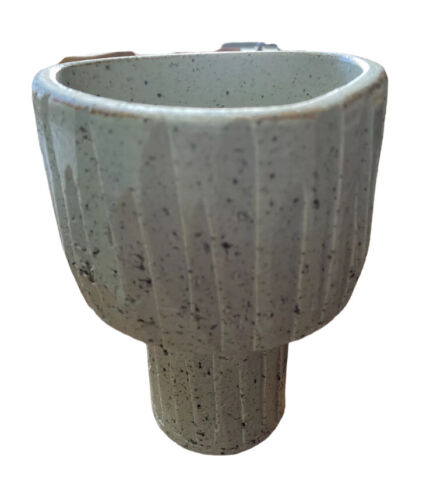
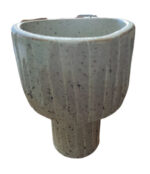
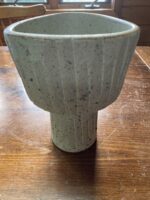
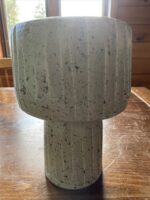
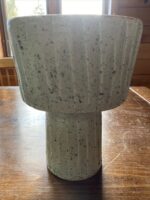
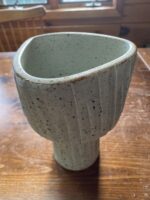
There is a quiet confidence to well-made Japanese pottery. Rather than relying on elaborate decoration or brilliant glazes, many twentieth-century Japanese ceramic artists embraced proportion, texture, and the natural beauty of clay itself. This vintage Japanese ikebana vase is a wonderful example of that philosophy, combining sculptural form with understated elegance in a vessel designed for one of Japan’s most celebrated artistic traditions.
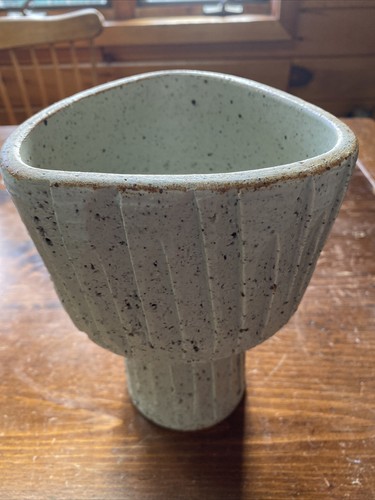
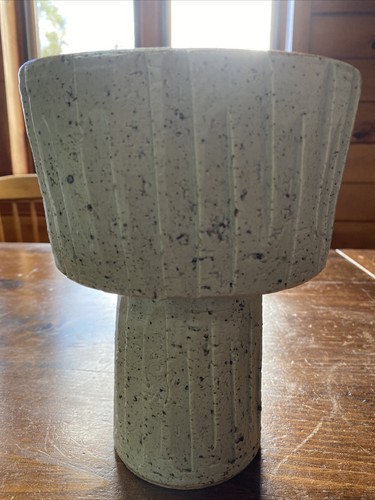
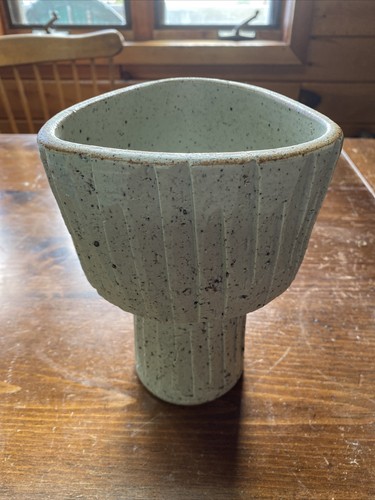
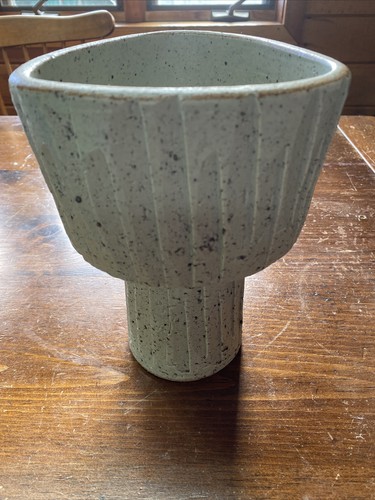
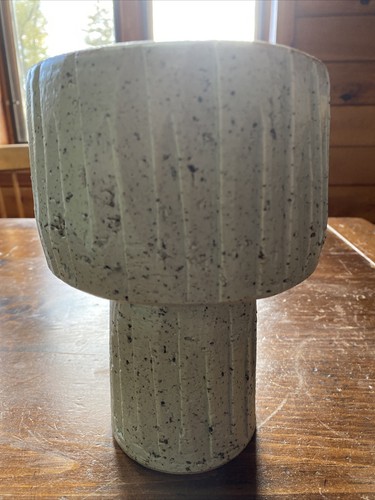
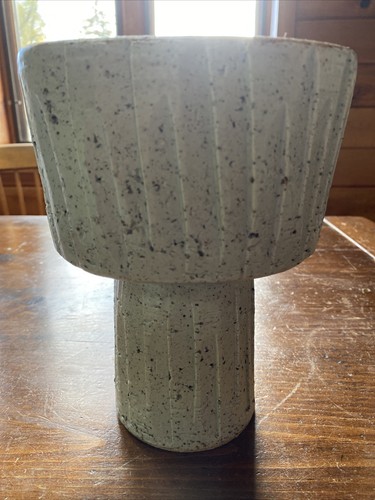
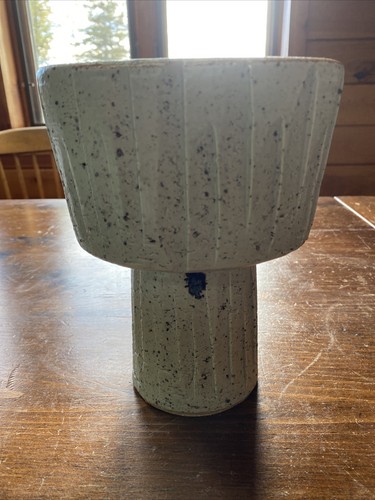
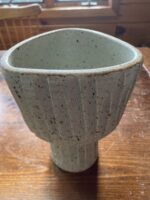
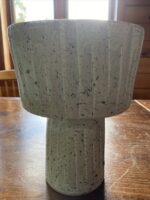
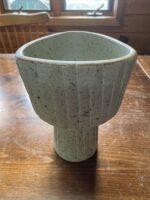
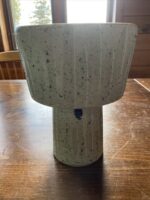
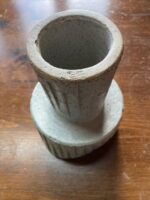
Standing on a tall cylindrical pedestal, the bowl rises above its base with crisp vertical fluting that creates an architectural appearance. The carved ribs catch light beautifully, emphasizing the clean geometry of the form while allowing the subtle, speckled stoneware glaze to remain the focal point. Finished in a soft gray-green glaze with naturally occurring iron speckles throughout, the vase possesses the quiet earthiness associated with many Japanese studio potteries during the Mid-Century Modern period.
The proportions are particularly striking. Rather than resting directly on a table, the elevated pedestal lifts floral arrangements into view, transforming the vessel itself into an artistic statement even before flowers are introduced. Empty, it functions as a sculptural ceramic object. Filled, it becomes part of the composition, supporting branches, grasses, seasonal blossoms, or minimalist botanical displays in the spirit of traditional Japanese flower arranging.
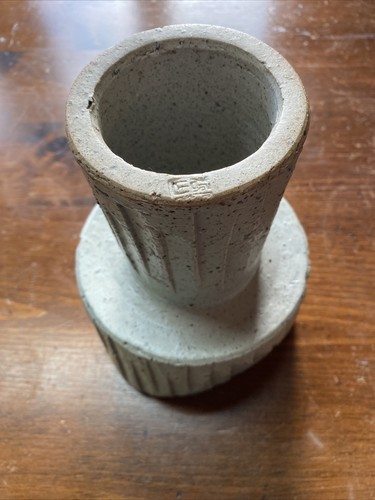
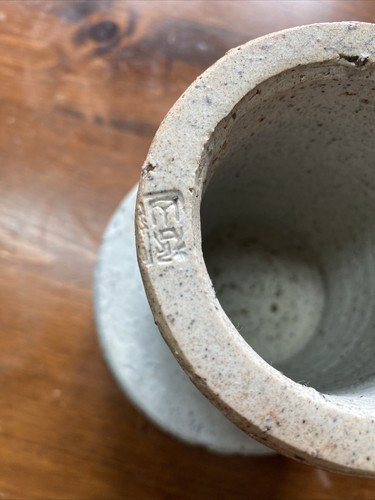
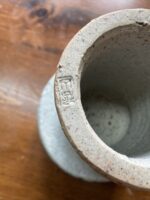
The underside bears an impressed Japanese maker’s mark, indicating workshop production rather than mass-market export decoration. While the exact kiln remains unidentified, the mark and construction are consistent with Japanese studio pottery produced during the post-war decades, when handcrafted ceramics enjoyed renewed international appreciation.
Whether displayed in a Mid-Century Modern interior, Scandinavian-inspired décor, Japandi design, or a contemporary minimalist home, this vase bridges cultures through timeless design.
Measurements
- Height: 8 inches
- Width: 5¾ inches
Condition
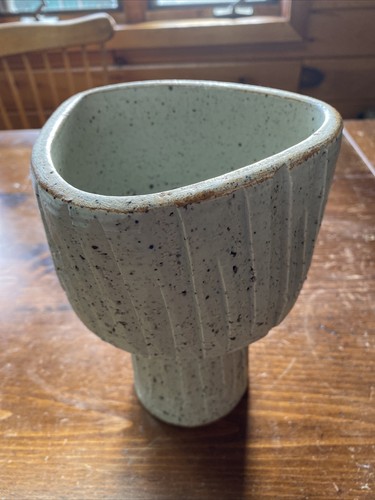
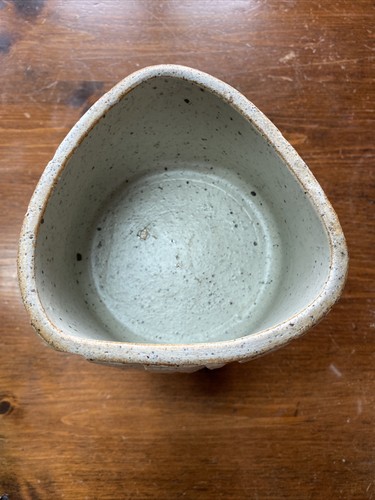
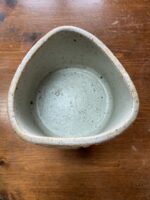
This vintage Japanese ikebana vase is in very good vintage condition, showing only light wear consistent with age and careful use. There is one notable glaze miss on the interior of the bowl, which occurred during the original firing process. This is a manufacturing characteristic rather than damage and does not affect the vase’s beauty, structural integrity, or functionality. Such kiln variations are commonly found in handcrafted Japanese studio pottery and are often appreciated as evidence of authentic artisan production. Please review all photographs carefully, as they are an important part of the description.
Research & Historical Notes
Japanese Ikebana and the Beauty of Simplicity
This vase was created for the traditional Japanese practice of ikebana, the centuries-old art of flower arranging that emphasizes harmony, proportion, balance, and the beauty of negative space. Unlike Western floral arrangements, which often focus on abundance, ikebana seeks to create a thoughtful dialogue between the flowers, the container, and the surrounding environment. Every element—including the empty space—is considered an essential part of the composition.
Pedestal forms such as this example are especially well suited to ikebana because they elevate the arrangement, allowing branches and blooms to appear almost sculptural. The vessel itself becomes an active participant in the artistic composition rather than merely serving as a container.
The vase reflects many of the characteristics collectors associate with Japanese Mid-Century studio pottery. Its vertically fluted body creates an architectural rhythm that enhances the simple cylindrical form, while the soft speckled glaze recalls the natural mineral surfaces favored by many Japanese potters during the post-war decades. Rather than relying on elaborate decoration, the maker allowed texture, proportion, and carefully controlled glaze to define the piece.
The impressed Japanese mark on the underside indicates workshop production, although the specific kiln has not been identified. Throughout the twentieth century, numerous respected kilns in regions such as Seto, Mino, Tokoname, Mashiko, and Shigaraki produced functional stoneware for both domestic use and export. Many pieces remain difficult to attribute today because smaller workshops often used local kiln marks rather than artist signatures. Regardless of attribution, these vessels are admired for their exceptional craftsmanship and timeless design.
The understated aesthetic of this vase also reflects principles associated with wabi-sabi—the Japanese appreciation for natural materials, quiet beauty, and subtle imperfections. The small glaze miss inside the bowl is a result of the original firing process and serves as a reminder that each handmade ceramic object possesses its own individual character.
Today, vintage Japanese ikebana vessels have become increasingly popular with collectors of Mid-Century Modern, Japandi, Scandinavian Modern, and studio ceramics. Their restrained forms complement contemporary interiors just as beautifully as traditional Japanese settings. Whether displayed with seasonal branches, dried botanicals, or simply admired as sculptural pottery, pieces such as this continue to demonstrate why Japanese ceramics remain among the most respected traditions in the history of decorative arts.
Why Pedestal Forms Matter
Pedestal bowls such as this one are particularly effective for Ikebana because they elevate the arrangement while maintaining visual lightness.
The raised foot allows flowers and branches to appear almost suspended, giving the arrangement greater presence without overwhelming a table or display surface. Elevated forms are especially popular for:
- Seasonal branches
- Cherry blossoms
- Camellias
- Iris
- Pine
- Grasses
- Wildflowers
- Contemporary sculptural arrangements
Even without flowers, pedestal vessels are appreciated as standalone works of ceramic sculpture.
Japanese Mid-Century Pottery
Following World War II, Japanese ceramics entered a remarkable period of international recognition. While traditional kilns such as Mashiko, Shigaraki, Bizen, Tokoname, Seto, and Mino continued centuries-old practices, a new generation of artists embraced modern aesthetics without abandoning handcrafted production.
Many potters rejected ornate decoration in favor of:
- Architectural forms
- Natural ash and feldspar glazes
- Stoneware bodies
- Visible throwing marks
- Textural surfaces
- Honest craftsmanship
These ideals resonated strongly with collectors of Scandinavian Modern, Danish design, and the growing Mid-Century Modern movement throughout Europe and North America.
Rather than imitate Western ceramics, Japanese artists refined centuries-old techniques into distinctly modern forms characterized by restraint and elegance.
The Influence of the Mingei Movement
Much of this aesthetic can be traced to Japan’s Mingei (Folk Craft) Movement, championed during the early twentieth century by philosopher Sōetsu Yanagi, along with renowned potters Shōji Hamada and Kanjiro Kawai.
Their philosophy celebrated the beauty of everyday handmade objects, believing true artistry existed in functional pieces crafted with sincerity rather than luxury.
The movement influenced countless studio potters throughout the twentieth century, encouraging:
- Functional beauty
- Honest materials
- Simplicity
- Traditional craftsmanship
- Natural glazing techniques
- Handmade individuality
Even when individual makers remain unidentified, many Japanese studio ceramics reflect these ideals through their quiet sophistication and exceptional craftsmanship.
Architectural Design in Clay
One of the most compelling aspects of this vase is its fluted exterior.
Vertical ribbing creates movement across the surface while strengthening the vessel visually. This architectural treatment echoes trends seen throughout Mid-Century Modern design, where repeated geometric forms appeared in architecture, furniture, textiles, and ceramics alike.
Unlike decorative carving intended purely for ornament, these flutes become part of the vessel’s structure, emphasizing height while creating ever-changing shadows as light moves across the surface.
Combined with the restrained glaze, the result is an object that feels simultaneously ancient and remarkably contemporary.
Stoneware and Natural Glazes
The glaze on this vessel displays numerous tiny iron speckles scattered across its soft gray-green surface.
These variations are not flaws but characteristics of high-fired stoneware. During firing, naturally occurring minerals within the clay and glaze react to kiln temperatures, producing subtle differences impossible to duplicate exactly.
Collectors often seek these organic variations because they serve as evidence of genuine kiln-fired craftsmanship rather than industrial production.
Every firing yields slightly different results, making each handmade vessel unique.
A Versatile Decorative Object
Although originally intended for Ikebana, vessels like this have become highly sought after by collectors of Mid-Century Modern and contemporary ceramics.
Today they are frequently displayed:
- As sculptural pottery
- With dried botanicals
- Holding bonsai displays
- With minimalist branch arrangements
- On bookshelves
- Coffee tables
- Floating shelves
- Entry consoles
- Gallery-style interiors
Their versatility allows them to complement interiors ranging from traditional Japanese aesthetics to modern Scandinavian, Wabi-Sabi, Brutalist, and contemporary design.
Collecting Japanese Studio Pottery
Collectors increasingly appreciate unsigned and workshop-produced Japanese ceramics because they embody the qualities that define great craftsmanship:
- Excellent proportions
- Exceptional glazing
- Functional artistry
- Honest handmade construction
- Timeless design
- Superior firing techniques
While many famous kilns and artists command substantial prices, beautifully made anonymous studio pottery remains one of the most accessible ways to own authentic Japanese ceramic art.
Pieces such as this continue to gain appreciation among collectors who value design over signatures and craftsmanship over ornamentation.
Why This Piece Matters
A thoughtfully crafted object doesn’t need a famous signature to deserve appreciation. This vintage Japanese ikebana vase represents the enduring beauty of functional design—where craftsmanship, proportion, and simplicity come together to create an object that is as compelling displayed on its own as it is holding flowers. At Art & Beautiful Things, we believe pieces like this preserve the artistic traditions that continue to inspire collectors, designers, and makers around the world.
Thank you for visiting Art & Beautiful Things. Please feel free to contact us with any questions or requests for additional photographs.
 (248) 617-7717
 mona@artandbeautifulthings.com