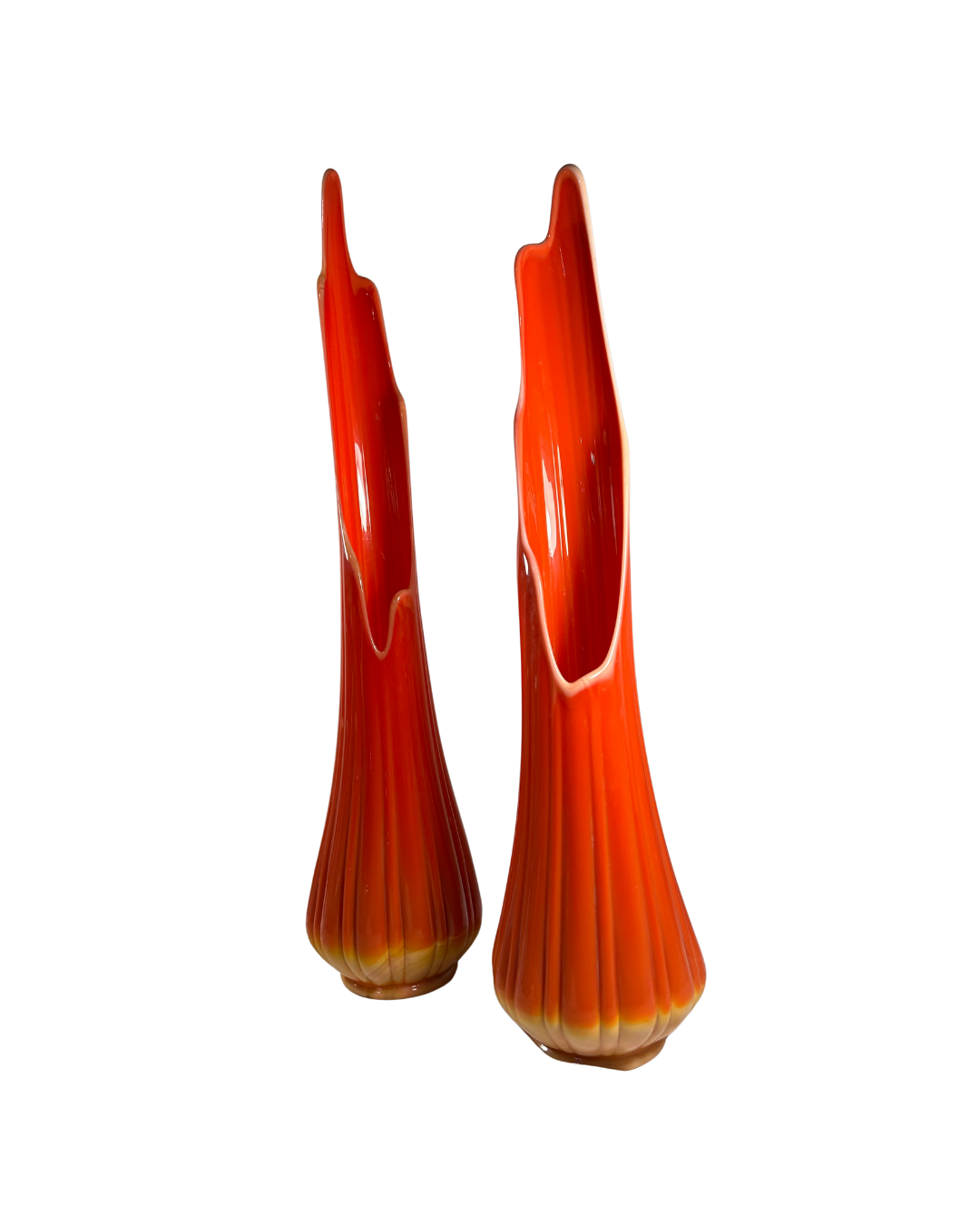
Art & Beautiful Things is pleased to offer this dramatic pair of vintage orange art glass vases, distinguished by their soaring silhouettes, fiery color, and unmistakable mid-century presence.
The pair immediately commands attention. Each vase rises from a rounded lower body into a tall, tapering neck. The glass stretches upward in a fluid, almost flame-like form. Rather than feeling heavy, the shapes appear to move.
That sense of motion is one of their most appealing qualities.
Rich orange glass dominates the design. Depending on the light, the color shifts from deep ember tones to brilliant orange-red. Subtle variations within the glass create additional depth. Near the bases, the color softens into warmer amber and honey tones.
Together, the two pieces resemble captured flames.
Although closely related in form, they are not identical. Slight differences in height, contour, and movement give each vase its own personality. Displayed side by side, those variations become part of the composition.
Vintage Orange Art Glass Vases with Sculptural Form
These vintage orange art glass vases reflect the dramatic approach to decorative glass that became popular during the mid-20th century.
Glassmakers increasingly explored elongated shapes, asymmetry, and bold color during this period. Decorative glass moved away from purely functional forms. Instead, designers treated vessels as sculpture.
This pair fits beautifully within that tradition.
The long necks draw the eye upward. Their irregular openings add movement and reinforce the handmade appearance. Meanwhile, the rounded bases provide visual stability.
That contrast creates balance.
The lower forms feel grounded and substantial. Above them, the glass narrows and rises dramatically. The result feels energetic without becoming chaotic.
A Blaze of Mid-Century Color
Orange became an important decorative color during the mid-century period.
Designers embraced warm tones such as amber, tangerine, persimmon, burnt orange, and red-orange. These colors appeared in glass, ceramics, textiles, furniture, and interior design.
They worked especially well with teak, walnut, brass, chrome, and natural stone.
This pair brings that same warmth into a modern setting.
Under softer lighting, the glass can appear rich and moody. In stronger light, the orange becomes far brighter and more luminous. Placed near a window, the color takes on an almost glowing quality.
For that reason, these pieces are especially effective when displayed where natural light can pass through them.
Form Inspired by Movement
The most striking feature of the pair is the elongated shape.
Each vase begins with a compact, bulbous base. From there, the body narrows and rises. The neck continues upward in a sweeping line before ending in an irregular opening.
The effect feels organic.
Rather than relying on applied decoration, the design depends on silhouette, color, and proportion. This approach was central to much modern studio and decorative glass.
A successful vessel did not need elaborate cutting or engraving. The glass itself became the decoration.
These vases demonstrate that philosophy beautifully.
Their surface remains visually clean. As a result, the eye focuses on the movement of the forms and the intensity of the color.
Designed to Be Displayed Together
While each vase can stand alone, the pair becomes more powerful when displayed together.
Their differing heights create rhythm. The similar color unifies them. At the same time, the slight variation in shape keeps the arrangement from feeling overly formal.
That balance makes them ideal for a console, mantel, dining table, sideboard, or display cabinet.
They would also work exceptionally well against a dark wall.
The vivid orange would become even more pronounced against black, charcoal, deep green, or navy. In a lighter interior, they provide a strong burst of color without overwhelming the room.
For collectors of mid-century design, the pair offers both decorative impact and sculptural interest.
Autumn, Halloween, and Seasonal Display
Although these pieces were not created as seasonal décor, their color makes them especially striking during autumn.
Their glowing orange-red glass recalls falling leaves, embers, candlelight, and late October sunsets. The tall, pointed silhouettes even suggest stylized flames.
That makes them an elegant alternative to traditional Halloween decorations.
Pair them with black candlesticks, antique books, pumpkins, dried branches, or dark pottery. The result can feel seasonal without becoming themed.
After autumn ends, the vases transition easily back into year-round display.
That versatility is part of their appeal.
Decorative Art Rather Than Simple Vessel
Objects such as these demonstrate why vintage decorative glass continues to attract collectors.
A vase can function as a container. However, the best examples also succeed when completely empty.
These pieces do exactly that.
Their value lies in the relationship between glass, color, shape, and light. No flowers are required.
Viewed from across a room, they read as sculpture. Up close, the subtle variations within the glass become more apparent.
The forms also change depending on the viewing angle. From one side, the necks appear narrow and refined. From another, their irregular contours become more dramatic.
That constant visual change gives the pair life.
Condition
Condition is consistent with age and use.
Please review all photographs carefully, as they form an important part of the condition description. Vintage art glass can display small variations created during production, including bubbles, tool marks, slight asymmetry, or variations in thickness.
Such characteristics may reflect the handmade nature of the glass rather than later damage.
Any specific chips, scratches, repairs, or other condition concerns should be noted separately if present.
Measurements
One measures 25″ and the other is 27″.
Research and Historical Notes
Mid-century decorative glass became increasingly sculptural during the decades following World War II.
European and American glassmakers experimented with dramatic scale, strong colors, stretched forms, and expressive silhouettes. Manufacturers and studios in Italy, Scandinavia, Central Europe, and the United States all contributed to the movement.
Designers often allowed the natural behavior of molten glass to influence the final form.
Pulled necks, stretched bodies, irregular openings, and organic contours became visual signatures of the period.
Orange and amber glass were particularly well suited to these designs. The colors interact beautifully with light and create a sense of warmth even when the vessel stands empty.
Without a confirmed signature or label, we prefer not to assign these vases to a specific maker. Their design, however, clearly places them within the broader tradition of expressive vintage art glass.
That honesty is important.
At Art & Beautiful Things, attribution should strengthen the story of an object, not replace careful observation.
Closing
This pair of vintage orange art glass vases combines everything we love about mid-century decorative design: bold color, sculptural form, movement, and individuality.
Their tall flame-like silhouettes create immediate drama. Rich orange glass gives them warmth. Slight differences between the two pieces make the pair feel collected rather than mechanically matched.
Displayed together, they become a striking focal point.
For the collector of vintage art glass, mid-century modern décor, or unusual sculptural objects, this pair offers an exceptional combination of color and form.
Thank you for visiting Art & Beautiful Things, where we enjoy finding and preserving beautiful pieces from the past.
 (248) 617-7717
 mona@artandbeautifulthings.com