(248) 617-7717
 mona@artandbeautifulthings.com




- 80s
- Art
- Abstract
- Art Deco
- Atomic
- Brutalist
- Ceramics & Pottery
- China & Porcelain
- Collectibles
- Decor
- Delightfully Kitschy
- Fashion
- Folk
- Fun
- Furniture
- Glass
- Gothic
- Holiday
- Historical Significance
- Hollywood Regency
- Industrial
- Kitchen
- Lighting
- Metal
- Mid Century
- Mid Century Modern
- Modern
- Off The Wall
- Old World
- Pop Art
- Primitive
- Rustic
- Salvage
- The Beauty Of Asia
- The Beauty of All Europe
- The Beauty of Canada
- The Beauty of France
- The Beauty of Italy
- The Beauty of Scandinavia
- The Beauty of the UK
- The Classics
- Whimsical
Antique German Christmas Ornaments: History of Lauscha Glass & Feather Tree Decorations

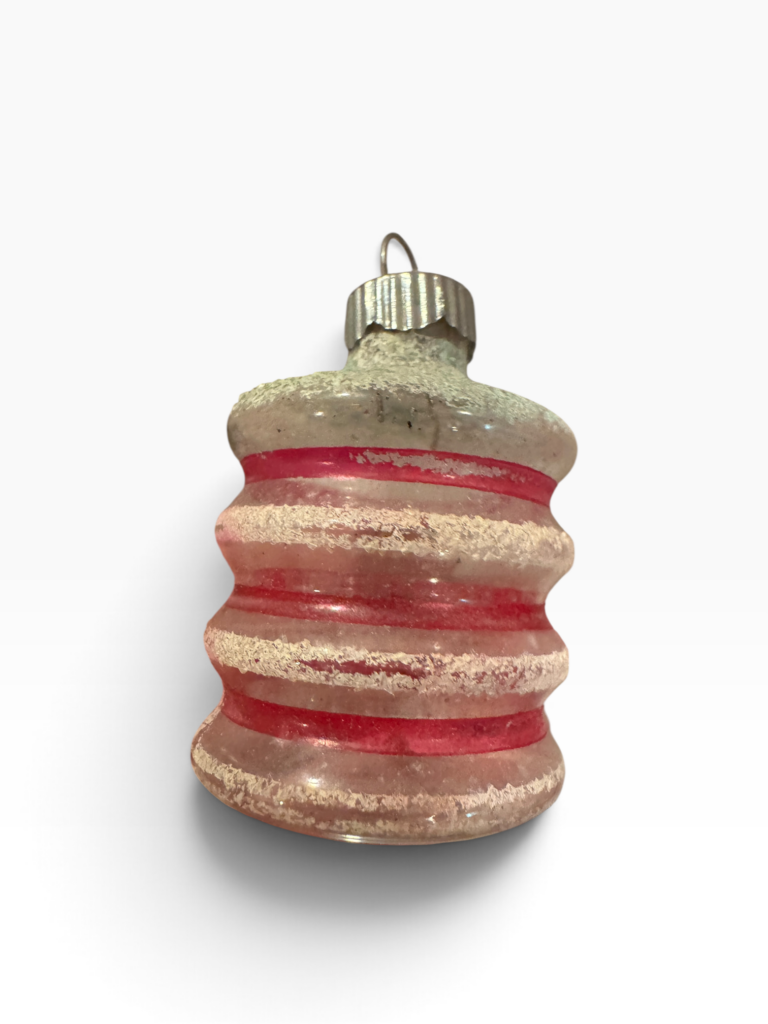
Long before American Christmas trees glittered with Shiny Brite balls, aluminum branches, and electric lights, the center of the glass ornament world sat deep in the Thuringian Forest of Germany. In the small town of Lauscha, generations of glassmakers developed a tradition that would eventually shape the appearance of Christmas trees throughout Europe and the United States. Their ornaments were fragile, luminous, imaginative, and often astonishingly intricate. More than a century later, surviving examples still carry the character of the workshops, families, and Christmas celebrations that created them.
The story of German Christmas ornaments is not simply the history of a decorative object. It is the story of a town built around glass, of family workshops where several generations might contribute to a single ornament, of changing technology, expanding international trade, war, migration, and the gradual transformation of Christmas itself.
Lauscha and the Birth of a Glassmaking Tradition
Lauscha’s connection to glass began long before anyone there thought of making Christmas ornaments. The Corning Museum of Glass traces the town’s glassmaking history to 1597, when the Greiner and Müller families received permission to establish a glassworks in the region. The surrounding Thuringian Forest offered the raw materials and fuel necessary for glassmaking, and over the following centuries the craft became deeply rooted in local life. Early production centered on practical and decorative wares such as table glass, flasks, beads, and other small objects.
As production grew, glassmaking gradually moved beyond the main factory. Lauscha developed a cottage industry in which glass rods and tubing could leave the central works and travel into family homes. There, artisans reheated the material over small lamps or burners and transformed it into beads, eyes, decorative objects, and eventually Christmas ornaments. The Deutsches Museum describes home production around 1900 in which the workbench and bellows might stand directly in the family living room. A glassworker softened a section of tubing, blew it freely into a sphere, or expanded it into a two-part mold to create a more complicated form.
This system gave Lauscha ornament production a distinctly human character. The finished object often passed through several pairs of hands. A glassblower shaped it, another worker might silver the interior, and someone else painted or embellished the exterior. The Corning Museum notes that women and children often participated in decorating, using brushes, dipping methods, or liquids poured into the ornament itself. Families and small workshops became part of an interconnected local industry rather than isolated makers producing every step alone.
Before glass ornaments entered the Christmas tree, families commonly used fruit, nuts, sweets, paper objects, and candles as decoration. Lauscha tradition preserves the story that in 1847 a glassworker named Hans Greiner began creating glass versions of fruits and nuts for his tree. The Corning Museum and the Deutsches Museum both repeat this account as part of the accepted local tradition, though it is best understood as the familiar origin story rather than a precisely documented moment of invention. What matters historically is that by the nineteenth century Lauscha had indeed developed a thriving craft in glass Christmas decoration.
Once glass entered the Christmas tree, the possibilities expanded quickly. A fruit did not have to remain merely a fruit. Glassworkers could shape nuts, berries, pears, grapes, stars, bells, flowers, animals, birds, pipes, teapots, houses, religious figures, and increasingly elaborate fantasy forms. Corning’s museum collection contains German ornaments demonstrating just how wide this vocabulary became, from walnuts and indented geometric balls to coffee pots, mushrooms, spun-glass religious scenes, and fruit forms covered with crushed glass.
Glass, Silver, and Candlelight
The beauty of an early German ornament began with extraordinarily thin glass. A skilled worker heated a section of tubing until it softened and then introduced air carefully enough to form a bubble without rupturing the walls. For simple forms, the artisan could work freehand. More elaborate ornaments required molds.
The earliest molds used in Lauscha could be carved from wood, though ceramic molds soon became preferable because they tolerated repeated heat and allowed more complex detail. The glassblower heated the tubing to the correct temperature, placed it in the mold, closed the two halves, and blew until the softened glass pressed into the carved surface. Although the mold provided the design, the process still required considerable control. Too little heat and the glass would not fill the detail; too much pressure or heat could ruin the piece completely.
This technique explains the extraordinary surfaces found on many antique German ornaments. A smooth sphere catches light in one broad reflection. Molded glass behaves very differently. Raised berries, fluted ribs, recessed stars, petals, leaves, and deeply indented geometric patterns break the light into smaller flashes. As the ornament turns, each surface changes. The glass itself becomes part of the decoration rather than simply the support for paint.
Silvering intensified that effect. The Deutsches Museum explains that the familiar mirrored finish results from depositing metallic silver against the interior glass wall through a chemical reaction. With a reflective layer inside, an otherwise transparent ornament could glow dramatically. Exterior lacquer and paint added still more depth, allowing artisans to produce silver, gold, green, rose, red, blue, and numerous subtler shades.
In the nineteenth century, those effects mattered enormously because Christmas trees often stood in candlelight. A flickering flame moving across thin silvered glass created a very different visual experience from modern overhead lighting. Deep ribs and indents threw tiny shadows. Silvered interiors caught points of light and reflected them back into the room. Even a small ornament could appear jewel-like.
This is one reason antique German ornaments can seem unexpectedly subdued when viewed today. Their silvering may have oxidized, colors may have mellowed, and modern electric lighting does not reproduce the atmosphere in which they first appeared. Yet the softened champagne, bronze, gray, pale gold, faded rose, and muted green surfaces that collectors now prize tell their own story. They represent the passage of time rather than a failure of the original craftsmanship.
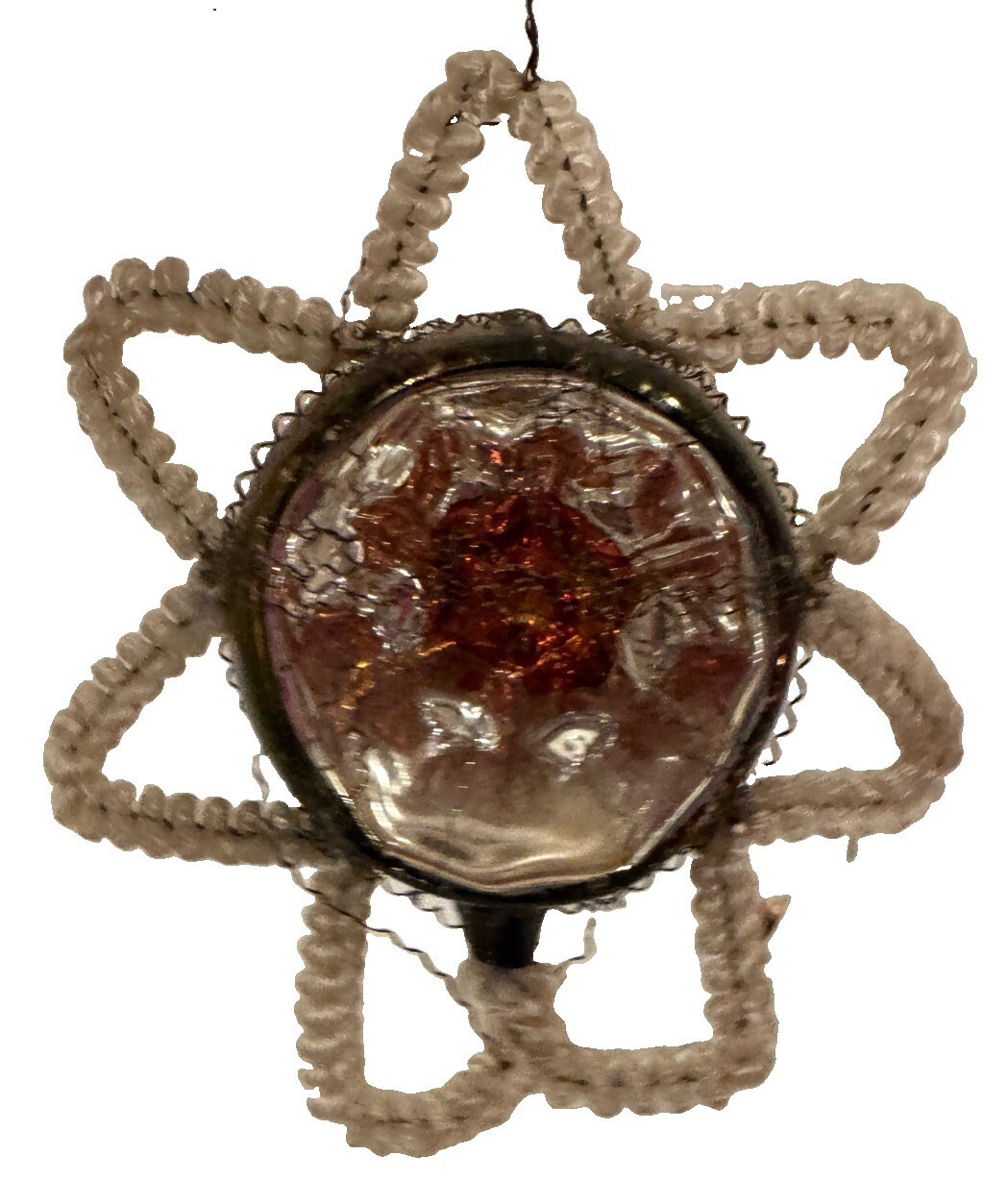
Museum collections also confirm how frequently German makers combined glass with other materials. The Smithsonian’s National Museum of American History holds early twentieth-century ornaments from Lauscha made with glass, metal, and wire, while other examples incorporate thread and additional materials. Corning preserves German ornaments that combine blown glass with paper, wire tinsel, spun glass, paint, and crushed-glass decoration.
Wire-wrapped ornaments belong to this larger tradition of combining fragile glass with delicate surface decoration. Fine metal wire could follow the contours of a form or create loops, zigzags, cages, and decorative bands around it. Today, surviving wire is often incomplete. More than a century of oxidation, movement, storage, and handling can reduce elaborate decoration to only a few remaining sections. Yet those fragments remain historically valuable because they show how much more complex the ornament once was.
The condition of an antique ornament must therefore be understood differently from the condition of a modern collectible. Silver loss, softened paint, oxidation, partial wire loss, and replaced caps may all reflect a century or more of ordinary Christmas use. These pieces were not created as museum objects. Families unpacked them in December, hung them from branches, removed them after Christmas, wrapped them, stored them, and repeated that process again and again.
Feather Trees and the Delicate Scale of Early Ornaments
Many small German ornaments make much more sense when viewed in the context of the feather tree.
German feather trees appeared during the nineteenth century and became one of the earliest forms of artificial Christmas tree. Historical societies preserve surviving examples made from dyed goose feathers attached to wire branches around a central wooden trunk. The branches stood widely apart, creating a sparse and highly structured silhouette. German immigrants later carried the feather-tree tradition to the United States, where the form became increasingly familiar around the turn of the twentieth century.
The Mahoning Valley Historical Society preserves a late nineteenth-century German feather tree decorated with Victorian-era ornaments, including glass balls, Dresden ornaments, tinsel-trimmed pieces, and candle holders. That surviving display provides an unusually useful glimpse into the kind of visual world in which small antique ornaments originally appeared.
On a feather tree, each branch offered open space rather than disappearing into dense greenery. Small decorations could therefore stand apart from one another. A tiny ribbed ball, a molded nut, a wire-wrapped ornament, or a miniature bird did not need to compete with dozens of surrounding branches. The tree presented each object almost individually.
That helps explain why so many early feather-tree ornaments appear surprisingly small to modern eyes. Their scale was part of their function. Dyed-feather branches were light and could not support the same weight as a heavy natural limb. Small, thin-walled glass ornaments suited them beautifully.
The open construction also worked well with candlelight. Historical sources note the wide spacing between feather-tree branches and the use of candles on these early artificial trees. The arrangement gave ornaments room to hang freely while helping keep nearby material away from the flame.
Imagine such a tree in a late nineteenth-century room: thin feather branches rising from a wooden base, small silvered glass ornaments suspended in open space, a few paper or Dresden decorations, perhaps candles glowing between them. It would have looked very different from the heavily layered trees of the twenty-first century. Rather than creating one large field of color, the tree invited the eye to move from object to object.
That difference is important because it reminds us that antique ornaments were designed for a visual culture unlike our own.
From a Thuringian Cottage Industry to an International Trade
By the later nineteenth century, Lauscha’s ornaments had moved well beyond the local Christmas tree. They had become commercial goods shipped around the world.
The Corning Museum describes Lauscha ornaments being carefully packed and distributed internationally, including to the United States. The Deutsches Museum notes that around 1880 a toy merchant from nearby Sonneberg added Lauscha Christmas ornaments to his trade and helped bring them into American retail channels, including Woolworth stores.
This expansion profoundly influenced American Christmas decorating. Long before an American company such as Shiny Brite became famous, German makers had already established much of the vocabulary consumers expected from a glass Christmas ornament: the silvered interior, brightly lacquered surface, molded fruit, bird, bell, pine cone, sphere, indent, and figural form.
Imported ornaments became more accessible as department stores, variety stores, and expanding international trade brought them into ordinary households. Families did not necessarily acquire complete matched sets at once. They often accumulated Christmas decorations gradually. A few glass balls might enter the family box one year, followed by a bird, a molded fruit, a wire ornament, or a new novelty several seasons later.
This helps explain why genuinely old Christmas collections often look wonderfully mismatched. They may contain ornaments from different years, makers, and traditions. Rather than diminishing their importance, that variety can reveal how Christmas decorating actually evolved within a household.
The German industry itself was remarkably diverse. Corning’s collection of German ornaments dating approximately 1930–1950 includes mold-blown walnuts, spherical balls with painted leaf and flower designs, deeply indented reflectors, fruit, mushrooms, household objects, and elaborate ornaments combining glass with paper, spun glass, wire tinsel, and crushed glass. Even relatively late German production maintained the inventive mixture of form and materials that had characterized the tradition for decades.
Collectors also encounter heavier antique German glass pieces often described today as kugels. The German word Kugel means simply “ball,” though the collecting world uses the term more specifically for substantial nineteenth-century glass ornaments and hanging decorations. These heavier pieces differ considerably from the feather-light thin-walled ornaments that later dominated the Christmas market. Both belong to the wider German tradition, but they served different decorative purposes and should not be treated as the same object merely because both were made of glass.
War, America, and the End of German Dominance
By the early twentieth century, German ornaments had become deeply embedded in American Christmas traditions. That dependence on imports also made the American market vulnerable to events in Europe.
World War I disrupted international commerce, yet the German ornament industry survived and resumed its importance afterward. Through the 1920s and much of the 1930s, German-made ornaments remained familiar in American homes.
World War II created a much more dramatic rupture.
Max Eckardt, a German-born businessman with direct connections to the ornament trade near Lauscha, recognized the danger before the war completely closed the market. The Corning Museum records that Eckardt and his brother had opened a toy and ornament factory in Oberlind, only about twenty miles from Lauscha, in 1926. After establishing a New York branch and immigrating to the United States, Eckardt founded the Shiny Brite Company in 1937 as the European political situation worsened.
Corning Glass Works then supplied the technology that allowed the American industry to expand on a scale impossible for a traditional cottage industry. During certain months, machinery originally developed for the production of lightbulbs produced enormous quantities of thin glass ornament blanks. Those blanks traveled to decorating facilities where workers silvered, lacquered, painted, and packaged them for sale.
The change was revolutionary, but it did not erase Germany’s influence. Quite the opposite. The American ornament industry grew from a market German glassmakers had already created. American buyers knew what silvered glass looked like because they had seen German ornaments. They recognized molded fruits, bells, balls, and figurals because German makers had sold them for generations.
Even Shiny Brite’s story leads directly back to the Thuringian ornament trade.
The war also changed Lauscha itself. After 1945, the town fell within the Soviet occupation zone and later East Germany. Corning notes that Lauscha’s location behind the new political divide cut off its ornament exports to the United States until the mid-1950s. By that point, American companies had established a strong domestic ornament industry.
Still, the craft survived.
A particularly moving glimpse of that continuity appears in Corning’s research on Lauscha glassworkers. During a later visit to the town, museum staff interviewed Gunter Knye, a sixth-generation lampworker whose family history in the region stretched back roughly three centuries. He remembered a community in which glasswork remained a cottage industry and families continued producing traditional items such as fruit and Christmas ornaments.
The industry had weathered wars, political borders, economic change, and industrial competition, yet the basic skills had not vanished.
What Survives in an Antique German Ornament
For today’s collector, the challenge lies in learning to see what an old ornament can and cannot tell us.
No single feature automatically proves that an ornament came from Germany or establishes an exact date. Thin glass can provide a clue, but thin glass continued into later periods. A long neck or pike may be significant, but it does not stand alone. Pontil marks, molded detail, silvering, caps, wire, paint, and construction all contribute evidence.
Caps deserve particular caution. They fall off easily. Families replace them. Loose caps migrate around storage boxes. An antique German ornament can wear a later American cap just as easily as an American ornament can acquire an older European one.
Original boxes, when they survive, are therefore immensely useful. Packaging can identify country of origin, manufacturer, retailer, assortment, and sometimes even the intended arrangement of the ornaments. Unfortunately, cardboard survives much less readily than glass. Families often discarded damaged boxes or transferred ornaments into newer containers, separating the glass permanently from its original identification.
Museum collections provide another valuable point of comparison. The Smithsonian catalogs early twentieth-century ornaments specifically from Lauscha that incorporate glass, wire, and metal, while Corning’s German holdings document the extraordinary variety of mold-blown, silvered, lacquered, painted, embossed, and applied decoration used by German makers. These institutional examples allow collectors to compare techniques rather than relying only on marketplace descriptions.
Age also deserves careful interpretation. A heavily worn ornament is not necessarily older than a brilliant one. Storage conditions make an enormous difference. Some early pieces survive with remarkably strong surfaces, while younger ornaments may have extensive silver loss.
For that reason, dating should come from the whole object rather than the amount of wear alone.
This is especially important with nineteenth-century and early twentieth-century pieces. A seller may be tempted to assign a dramatic date simply because an ornament looks primitive. Responsible attribution requires a little more restraint. An ornament can still be historically important without forcing it into a narrower date range than the evidence supports.
More Than Decoration
The greatest appeal of antique German Christmas ornaments may ultimately have little to do with rarity.
These are fragile objects that somehow survived a world they were never expected to outlive.
A glassblower heated the tubing. Someone formed the bubble. Another person may have silvered it. A woman or child might have added paint. Someone wrapped wire around the surface or tucked the finished ornament into a box. A merchant transported it out of Thuringia. Perhaps it traveled by ship to America. Eventually someone purchased it and took it home for Christmas.
Then the quieter history began.
A family unpacked it.
Someone found a place for it on the tree.
Candlelight or, later, electric light moved across its silvering.
After Christmas, someone removed it carefully and put it away.
The following December, the family did it again.
Perhaps children grew up around it. Perhaps the ornament passed from parent to child. Perhaps it moved across states, survived an attic, a basement, a war, a house sale, or an estate box that nobody opened for decades.
A hundred years later, the wire may be incomplete. The brilliant silver may have become champagne. The pink may have faded. A cap may no longer be original.
Yet the glass remains.
That survival is the reason antique German Christmas ornaments deserve to be understood as more than pretty holiday decorations. They preserve one of the foundational traditions of the modern Christmas tree. Lauscha’s glassmakers transformed ordinary fruit and familiar household forms into shimmering objects of celebration. Their work traveled across oceans, shaped American taste, influenced the rise of domestic ornament manufacturing, and helped establish the visual language of Christmas that still surrounds us.
A modern ornament begins its life without history.
An antique German ornament already carries generations of it.
And every Christmas in which one of these fragile pieces returns to a tree adds another chapter to a story that began, remarkably, in the glassmaking workshops of the Thuringian Forest.