(248) 617-7717
 mona@artandbeautifulthings.com




- 80s
- Art
- Abstract
- Art Deco
- Atomic
- Brutalist
- Ceramics & Pottery
- China & Porcelain
- Collectibles
- Decor
- Delightfully Kitschy
- Fashion
- Folk
- Fun
- Furniture
- Glass
- Gothic
- Holiday
- Historical Significance
- Hollywood Regency
- Industrial
- Kitchen
- Lighting
- Metal
- Mid Century
- Mid Century Modern
- Modern
- Off The Wall
- Old World
- Pop Art
- Primitive
- Rustic
- Salvage
- The Beauty Of Asia
- The Beauty of All Europe
- The Beauty of Canada
- The Beauty of France
- The Beauty of Italy
- The Beauty of Scandinavia
- The Beauty of the UK
- The Classics
- Whimsical
Harry Heim and Santa Novelties: The Forgotten Christmas Ornament Empire of Santa Heim, Maryland

There are Christmas stories that sound too fanciful to be true.
A businessman buys an entire Maryland mill town. He fills it with Christmas lights, reindeer, circus performers, toy trains, storybook characters, and millions upon millions of glass ornaments. He dresses as Santa Claus. He attempts to rename the community after himself.
And for a brief moment, he dreams of turning it into America’s year-round Christmas capital.
It sounds like a Hollywood movie.
But it happened.
The man behind the dream was Harry Harrison Heim, founder of Santa Novelties, Inc., and for several remarkable years during the 1940s, his company became one of the largest producers of Christmas ornaments in the United States.
Today, Heim ornaments are far less familiar to the general public than Shiny Brite. Yet collectors increasingly recognize their importance.
Their story combines American manufacturing, department-store merchandising, wartime opportunity, hand decoration, glassmaking, and one of the strangest chapters in American Christmas history.
At its center was Harry Heim.
And Harry Heim did nothing halfway.
From Baltimore to California
Harry Harrison Heim was born in Baltimore, Maryland, in 1883.
Before World War I, he moved west and eventually settled in San Diego, California. There, he worked in retail and became involved in merchandise display at the Marston Company department store.
That background matters.
Heim was not simply a manufacturer. He understood presentation.
He understood spectacle.
He understood how visual excitement could persuade people to stop, look, and buy.
Those instincts would later shape not only his ornaments but his extraordinary vision for an entire Christmas-themed town.
During the difficult years of the Great Depression, Heim eventually returned to Baltimore. Historical accounts place his return in the early 1930s, after the failure of a clothing business in California. He then worked in commercial decorating and display.
It was from that world of seasonal decorating that his Christmas business began to emerge.
The Birth of Santa Novelties
By the late 1930s, Heim had begun making Christmas decorations.
Early products reportedly included inexpensive decorative novelties before Heim moved increasingly toward blown-glass Christmas ornaments.
By 1941, Santa Novelties, Inc. had formally emerged as a Baltimore company.
The timing could hardly have been more significant.
For generations, Americans had relied heavily on imported European Christmas ornaments, particularly those made in Germany.
Then World War II disrupted that trade.
Suddenly, American retailers needed domestic suppliers.
Companies including Shiny Brite, Corning-associated ornament producers, and Santa Novelties rushed into that opening.
Harry Heim found himself in exactly the right industry at exactly the right moment.
Learning to Make Glass Ornaments
Heim did not begin as a master glassmaker.
According to historical accounts, his early attempts at producing glass Christmas balls were difficult. Heim later recalled that he and his workers had to learn the process through experimentation.
Eventually, they succeeded.
And once Santa Novelties found its formula, production expanded with astonishing speed.
By 1944, Santa Novelties reportedly produced approximately 12 million Christmas tree balls annually. About 90 percent of those ornaments went to F.W. Woolworth, one of the largest variety-store chains in the country.
That relationship gave Heim something any manufacturer dreams of having:
A national customer.
Woolworth stores could place Santa Novelties ornaments in front of shoppers across the country.
What had begun as a struggling decorating enterprise was becoming a major American Christmas business.
Harry Heim and Corning Glass
Santa Novelties was also connected to another major force in American ornament production: Corning.
Corning had developed machinery capable of producing enormous quantities of thin glass ornament blanks using technology adapted from lightbulb production.
Santa Novelties purchased glass blanks from Corning and then finished, decorated, painted, and packaged them for sale.
This point is especially useful for collectors because American ornament companies of the era often existed within a larger manufacturing network.
One company might produce the glass blank.
Another might silver it.
Another might paint or stencil it.
Another might package and distribute it.
Therefore, identifying a vintage ornament is rarely as simple as saying, “This shape belonged exclusively to this company.”
Caps, boxes, decoration, construction, and provenance all matter.
Santa Novelties During the War Years
Like Shiny Brite, Santa Novelties benefited from wartime demand for American-made ornaments.
Before the war, Germany dominated much of the American glass ornament trade.
When that supply disappeared, millions of Christmas trees still needed decorations.
American companies filled the gap.
Santa Novelties grew rapidly.
Historical research indicates that company sales climbed from about $61,000 in 1943 to more than $1.6 million by 1948.
That is extraordinary growth in only five years.
It also explains what happened next.
Harry Heim needed more room.
A lot more room.
The Savage Mill Opportunity
About twenty miles from Washington, D.C., stood the enormous Savage Manufacturing Company complex in Savage, Maryland.
For more than a century, Savage Mill had produced cotton duck and other heavy textiles.
The mill prospered during World War II. Once the war ended, however, demand collapsed.
In 1947, the textile operation closed.
The shutdown threatened not merely a factory but an entire company town. The Savage Manufacturing Company had owned worker housing, utilities, and other community infrastructure.
Hundreds of people suddenly faced an uncertain future.
Then Harry Heim arrived.
He saw abandoned industrial space.
He saw available workers.
He saw houses.
He saw land.
But more than anything else, he saw a stage.
Harry Heim Buys a Town
In 1947–48, Heim and Santa Novelties acquired the Savage Mill property and much of the surrounding town for a reported $450,000.
The purchase included nearly 500 acres and roughly 175 houses associated with the old mill community.
Most businessmen would have converted the mill into a larger factory.
Harry Heim had another idea.
He wanted to turn Savage into Christmas.
Not just at Christmas.
All year.
Welcome to Santa Heim, Merrieland
Heim began promoting his dream of transforming Savage into a permanent Christmas village.
He even proposed changing the name of the town from Savage, Maryland to:
Santa Heim, Merrieland.
It was an outrageous pun.
Santa Heim sounded like “Santa’s home.”
Merrieland played on Maryland.
And Heim placed his own surname directly in the center of it.
The official name change never happened, but that did not stop him from using the Santa Heim identity in advertising and promotional materials.
Some surviving Santa Novelties packaging actually carries the Santa Heim name.
For ornament collectors today, that packaging is among the most fascinating evidence of Heim’s short-lived Christmas empire.
A Town Turned Into Christmas
By December 1948, Heim had transformed much of Savage into an elaborate holiday attraction.
Thousands of lights decorated the town.
Reindeer lived near the community hall.
Storybook scenes appeared throughout the streets.
Workers and residents dressed as Santas and fairy-tale characters.
Visitors could watch ornament production and purchase Christmas goods.
A miniature railroad helped move guests.
There was even a circus.
For the grand opening on December 11, 1948, special trains carried visitors from Baltimore and Washington to the celebration.
Imagine arriving in a small Maryland mill town in 1948 and discovering that the entire place had apparently been handed over to Santa Claus.
For children, it must have been extraordinary.
For Harry Heim, it was marketing on a monumental scale.
The Ornament Factory Inside Savage Mill
Behind all the theatrical Christmas magic, Santa Novelties remained a serious manufacturing operation.
Former mill workers joined experienced ornament makers inside the enormous complex.
Workers painted ornaments.
They decorated them.
They finished them.
They packaged them.
Glassblowing demonstrations also became part of the public attraction.
Historical accounts differ slightly on exact production totals, but all agree that output was enormous.
Savage Mill reports that Santa Novelties produced approximately 75 million ornaments in 1948, accounting for more than 60 percent of American Christmas ornament production that year. Other historical accounts cite figures around 65–70 million during the height of operations.
Even allowing for differences in period reporting, the scale was remarkable.
Santa Novelties was not a tiny regional ornament shop.
It was an industrial Christmas powerhouse.
Santa Novelties at the White House
One of the most remarkable episodes came in 1948.
According to Savage Mill’s historical research, Santa Novelties ornaments decorated the White House Christmas tree that year.
For Harry Heim, that must have represented an extraordinary achievement.
His ornaments had gone from factory production to one of the most visible Christmas trees in America.
The moment also demonstrates how significant Santa Novelties had become.
Today, that national stature is easy to overlook because the company disappeared so quickly.
What Do Harry Heim Ornaments Look Like?
This is where the story becomes especially interesting for collectors.
Unlike a modern company whose products can be identified through detailed catalogs, Santa Novelties ornaments do not always announce themselves clearly.
The company produced a broad range of glass Christmas balls and decorated ornaments.
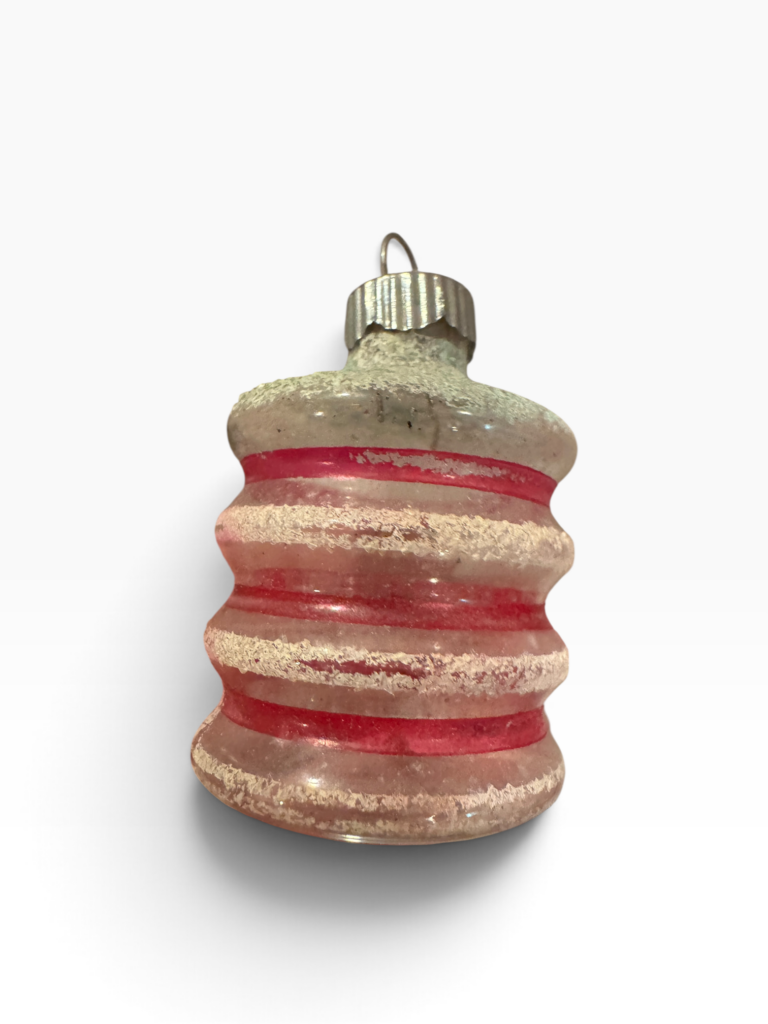
Examples associated with Santa Heim and Santa Novelties include striped balls, stenciled ornaments, snowmen, bells, solid-color designs, silvered balls, and other painted decorations.
Many were hand decorated.
Local historical research on surviving ornaments specifically notes hand-painted stencil designs, including motifs such as snowmen and bells.
That handwork means two seemingly identical ornaments may show subtle differences.
A line may sit slightly higher.
A stencil may shift.
Paint coverage may vary.
Those tiny imperfections are often part of the charm.
Look at the Cap
For collectors trying to identify Santa Novelties ornaments, the cap can provide an important clue.
Researchers and collectors associated with the Savage Historical Society have documented caps stamped:
MADE IN U S OF A
One collector involved in the Santa Heim historical exhibit noted that Santa Novelties and Corning appear to have used a particular lightly stamped cap style bearing those words.
But caution is important.
Caps can be changed.
Families have been swapping ornament caps accidentally for eighty years.
A loose cap may fall off in a storage box and get placed on the wrong ornament.
Therefore, a cap alone should never be treated as absolute proof.
The strongest identification combines several clues:
the ornament,
the cap,
the decoration,
the box,
and ideally known provenance.
Original Santa Novelties Boxes
For collectors, original packaging can transform an interesting ornament into a much more significant historical object.
Known Santa Novelties boxes may carry the company name directly.
Some later packaging includes:
Santa Heim
Savage, Maryland
San Diego, California
Santa Novelties, Inc.
Surviving examples include boxed ornament assortments and even unusual decorating kits containing small glass balls, a tree topper, and wire forms.
This packaging helps connect the ornament directly to Heim’s company.
It also captures the theatrical branding surrounding Santa Heim.
A cardboard box that might once have been thrown away after Christmas can now provide some of the best documentation for the ornaments inside.
Why Complete Boxes Matter
This is something vintage Christmas collectors understand immediately.
An individual ornament may survive easily.
A complete box rarely does.
Over eight decades, ornaments break.
Children inherit a few.
Families divide collections.
Boxes collapse in damp basements.
Someone transfers ornaments into plastic storage bins and discards the old cardboard package.
Eventually the connection between the ornaments and their manufacturer disappears.
That is why surviving Santa Novelties boxes are so useful.
They preserve context.
Suddenly, we are not simply looking at twelve old glass ornaments.
We are looking at a group that once left Harry Heim’s company together.
That changes the historical value of the collection.
Were Heim Ornaments Hand-Blown?
This is an area where descriptions require some care.
Historical accounts often describe Santa Novelties as a manufacturer of hand-blown and hand-painted Christmas ornaments, and Heim did employ glassblowers.
At the same time, Santa Novelties also had a documented relationship with Corning and purchased machine-produced glass ornament blanks.
Both things can be true.
Production practices may have varied by date, factory, ornament type, and production demand.
Therefore, unless a specific ornament has strong documentation, I would avoid automatically calling every Santa Novelties ornament hand-blown.
Hand-decorated, however, is well documented for many surviving examples.
That distinction matters when preserving accurate ornament history.
The Dream Begins to Unravel
Harry Heim’s imagination was enormous.
Unfortunately, enormous dreams are expensive.
The Santa Heim attraction required buildings, lighting, entertainment, animals, employees, maintenance, and constant promotion.
Then Heim encountered other problems.
In 1949, he faced tax charges related to unpaid taxes and an incorrect refund request. The matter ultimately resulted in payment of taxes and a relatively modest $100 fine, but the publicity was damaging.
Local regulations also caused trouble.
At one point, Sunday entertainment restrictions interfered with Santa Heim operations.
Fire-safety problems later disrupted parts of the Christmas attraction.
Meanwhile, the postwar ornament market was changing.
Imports were returning.
Competition increased.
Retailers again had more sources for inexpensive Christmas goods.
Heim had expanded rapidly and spent heavily.
The numbers eventually stopped working.
The End of Santa Novelties
By 1950, Santa Novelties was struggling badly.
Parts of the property were sold.
The business collapsed soon afterward, and assets were ultimately sold.
The mill passed into other ownership.
By 1951, the extraordinary Santa Heim experiment was essentially over.
Harry Heim died in 1953.
He had been 69 years old.
His great Christmas empire had lasted only a fraction of his life.
Yet those few years created a story that people in Savage still remember generations later.
The Man Who Wanted Christmas to Last All Year
It would be easy to tell Harry Heim’s story simply as the rise and fall of an overextended businessman.
That would miss what makes it interesting.
Heim clearly possessed an extraordinary ability to imagine experiences.
He did not see a closed textile mill.
He saw an ornament factory.
He did not see a struggling mill town.
He saw Santa’s village.
He did not see a company store.
He saw a Christmas shop.
He did not see ordinary industrial tourism.
He saw reindeer, trains, lights, circuses, storybook characters, and Santa arriving to crowds.
That instinct may have eventually pushed him beyond what his finances could sustain.
But for a short time, he actually made much of it happen.
Thousands came.
Children saw reindeer.
Factory workers made millions of ornaments.
And boxes marked Santa Heim, Savage, Maryland traveled into American homes.
Why Harry Heim Ornaments Matter Today
Collectors know Shiny Brite.
They know German kugels.
They know Czechoslovakian ornaments.
They know Poland.
Increasingly, however, serious collectors are beginning to appreciate lesser-known American manufacturers such as Santa Novelties.
Harry Heim ornaments deserve that attention.
They represent a specific and fascinating moment in American Christmas history.
They are connected to the collapse of European ornament imports during World War II.
They tell the story of rapidly expanding domestic manufacturing.
They connect directly to Woolworth, one of the great American retail chains.
They reveal the relationship between Corning glass production and independent ornament decorators.
And above all, they survive from a company whose founder once tried to turn an entire Maryland town into Christmas.
Few Christmas ornaments come with a better story.
Collecting Santa Novelties Today
Identification can be challenging.
Collectors should look beyond the ornament itself.
Original boxes are particularly valuable for research.
Caps marked MADE IN U S OF A may provide supporting evidence.
Hand-painted stencils and period decoration styles can offer additional clues.
Santa Heim-branded packaging provides an especially strong connection to the Savage years.
However, collectors should remain cautious with loose ornaments.
Many American factories used similar Corning blanks.
Shapes overlapped.
Caps traveled from ornament to ornament.
Decorating styles were sometimes similar between manufacturers.
For that reason, certainty should come from evidence rather than enthusiasm.
An ornament does not become a Heim simply because it resembles one.
That careful approach ultimately makes authentic examples more interesting.
A Christmas Empire Preserved in Glass
Perhaps the most remarkable thing about Harry Heim’s story is how much of it survives in such fragile objects.
Thin glass balls.
Cardboard boxes.
Metal caps.
Painted snowmen.
Tiny bells.
A faded label reading Santa Novelties.
These objects survived even after the factories closed and the crowds disappeared.
The reindeer are gone.
The circus is gone.
The special trains no longer arrive filled with children.
Savage never officially became Santa Heim, Merrieland.
But somewhere, every Christmas, one of Harry Heim’s ornaments still comes out of a box.
Someone places it on a tree.
Light catches the old silvering.
And for a moment, Harry Heim’s impossible Christmas town exists again.
That may be the most fitting legacy for a man who wanted Christmas to last all year