Blog Post

George Franke Sons: The Forgotten Rival of Shiny Brite and the Golden Age of American Christmas Ornaments

The remarkable story of German-American entrepreneurship, American glassmaking, and the colorful ornaments that decorated Christmas trees across the country.

When Christmas Sparkled with American Glass

There was a time when Christmas morning began beneath the shimmering branches of a freshly cut tree, its fragrant needles decorated with delicate glass ornaments that reflected the warm glow of electric Christmas lights. Brilliant red spheres nestled among emerald green branches, while golden ornaments, silvered reflectors, and hand-decorated glass bulbs transformed an ordinary evergreen into something magical.

For millions of American families during the middle decades of the twentieth century, these ornaments became inseparable from the memories of Christmas itself.

Some arrived in cheerful cardboard boxes purchased at neighborhood department stores. Others were carefully selected from colorful displays at Woolworth’s, where Christmas decorations filled the aisles with the promise of the approaching holiday.

Year after year, families unpacked the same ornaments, gently lifting them from their cardboard compartments and placing them on the tree.

Today, many of those beautiful decorations survive as treasured reminders of Christmases past.

Among the American companies responsible for bringing these sparkling ornaments into homes was George Franke Sons Company of Baltimore, Maryland.

Although collectors frequently recognize the Shiny Brite name, the story of George Franke Sons reveals another important chapter in the development of American Christmas ornaments.

It is a story of immigration, entrepreneurship, industrial innovation, and the remarkable transformation of an ancient European tradition into a thriving American industry.

The German Roots of an American Christmas Tradition

Long before American factories began producing glass Christmas ornaments by the millions, the delicate decorations hanging on American Christmas trees largely originated in Europe.

The German town of Lauscha, situated in the mountainous region of Thuringia, became especially celebrated for its glassmaking traditions.

Generations of skilled craftspeople worked with glass, creating delicate ornaments in workshops where knowledge passed from one generation to another.

By the nineteenth century, Lauscha’s glassblowers had developed an extraordinary variety of Christmas decorations, including shimmering spheres, fruits, birds, and imaginative figural ornaments.

These delicate creations gradually found enthusiastic buyers far beyond Germany.

In the United States, the growing popularity of decorated Christmas trees created a substantial market for imported European ornaments.

American retailers recognized their commercial potential. By the late nineteenth century, F. W. Woolworth was importing German glass Christmas ornaments for sale in his stores.

For decades, German manufacturers dominated the American market.

Yet the very success of imported ornaments created opportunities for entrepreneurs who believed the decorations could eventually be produced more economically in the United States.

Among those who helped establish an American Christmas ornament industry were German immigrants and their descendants, including the families associated with Max Eckardt and George Franke.

Their businesses would eventually become competitors in a rapidly expanding market.

George Franke Sons and the Baltimore Connection

George Franke Sons Company operated from Baltimore, Maryland, a city with a substantial German-American heritage and a long history of manufacturing and commercial enterprise.

The company’s founder, George Franke, established a business whose identity reflected both its American ambitions and its European roots.

According to Christmas ornament historian Jody L. Pritzl, the Franke family’s Baltimore factory stood on Eutaw Street. Its architecture included a decorative capital letter F, a symbol connected to the family’s European heritage.

That same distinctive emblem later appeared on Franke Christmas ornament packaging.

It was more than a decorative trademark. It represented a family business that had carried elements of its European identity into American manufacturing.

The company’s development also reflected a complicated commercial environment.

Import tariffs, international competition, and changing trade policies affected the profitability of selling European Christmas ornaments in the United States.

For businesses such as George Franke Sons, American production offered an opportunity to reduce dependence on imported merchandise.

The company would eventually become an important participant in the domestic Christmas ornament industry, competing for the attention of American retailers and consumers.

Its history reminds us that the development of American Christmas ornaments was not the achievement of a single manufacturer.

It involved multiple companies, competing brands, immigrant entrepreneurs, and industrial partnerships.

The Glassmaking Revolution in Wellsboro, Pennsylvania

The late 1930s brought enormous changes to the American Christmas ornament industry.

Political instability in Europe threatened the supply of German glass decorations, creating serious concerns for American retailers who depended on imported ornaments.

At the same time, American glass manufacturers possessed industrial technology that could potentially transform ornament production.

The breakthrough came at Corning Glass Works in Wellsboro, Pennsylvania.

Corning had developed machinery capable of producing glass light bulbs in enormous quantities.

The challenge was adapting that technology to manufacture Christmas ornaments.

According to the Wellsboro Glass Historical Association, representatives of the Christmas ornament industry approached Corning about modifying its ribbon machine to produce glass spheres.

The experiment succeeded.

In 1939, approximately one million glass Christmas ornaments emerged from the Wellsboro factory.

What had once required individual glassblowers working at their benches could now be accomplished through mechanized production.

The results transformed the industry.

By 1940, Corning had introduced equipment for silvering and coloring the glass ornaments, allowing the factory to produce approximately 40 million finished decorations that year.

American Christmas ornament production had entered an entirely new era.

Yet Corning did not simply sell ornaments under one familiar brand.

It supplied glass ornaments to several companies that decorated, packaged, and marketed them to American consumers.

George Franke Sons was among those important customers.

George Franke and Shiny Brite: Two Names, One Remarkable Industry

Today, the name Shiny Brite has become almost synonymous with vintage American glass Christmas ornaments.

Its colorful boxes and sparkling decorations are familiar to collectors, and the company’s association with Max Eckardt is widely recognized.

However, this popularity has sometimes obscured the contributions of competing manufacturers.

George Franke Sons was one of those competitors.

Historian Jody L. Pritzl, author of Immigrants, Ornaments and Legacies: A Story of American Made Glass Christmas Ornaments, researched the relationships between American ornament companies and their suppliers.

Her research revealed that George Franke Sons played a substantial role in the industry and competed directly with Shiny Brite.

Both companies purchased ornaments manufactured by Corning Glass Works.

Although the glass blanks could originate from the same factory, the finished ornaments were marketed under different brand names.

Each company developed its own packaging, decoration, and commercial identity.

Pritzl also documented that George Franke Sons supplied ornaments to Woolworth’s, challenging the simplified historical narrative that focuses almost exclusively on Shiny Brite.

One particularly remarkable figure illustrates the company’s scale.

According to Pritzl’s historical account, Corning supplied approximately 25 million glass bulbs to George Franke Sons for decoration during the period discussed in her history of the industry’s mid-century expansion.

This was not a small operation producing a handful of ornaments for local customers.

George Franke Sons participated in a major national industry that helped decorate Christmas trees throughout the United States.

The company deserves recognition alongside the better-known names of American Christmas ornament manufacturing.

The Artistry of George Franke Christmas Ornaments

Although industrial machinery made it possible to manufacture glass ornaments in extraordinary quantities, their decorative appeal remained central to their success.

The familiar round glass Christmas ornament became a canvas for an astonishing variety of colors and designs.

Brilliant reds, shimmering golds, vivid greens, delicate pinks, and rich blues reflected the changing tastes of American consumers.

Silvered interiors enhanced the reflective qualities of the glass, while colored exterior finishes created the luminous appearance that collectors continue to admire.

Some ornaments featured simple, elegant coloring. Others displayed decorative stripes, glitter, mica, or more elaborate patterns.

Among the most appealing examples are vintage ornaments with stenciled decoration.

These designs could incorporate cheerful seasonal imagery, stylized landscapes, or decorative motifs that reflected the optimism and visual character of mid-century Christmas.

The contrast between a brightly colored glass background and a carefully applied stencil could produce a surprisingly sophisticated composition.

A small glass sphere became a miniature decorative artwork.

The company’s surviving ornaments also reveal considerable variation in size and presentation.

Miniature glass ornaments were marketed for small tabletop trees, centerpieces, decorative sprays, and even package embellishments.

Larger ornaments provided dramatic accents for full-sized Christmas trees.

Original Franke packaging offers additional insight into the company’s marketing.

Some surviving boxes feature the distinctive Franke name and decorative insignia, while others emphasize the ornaments’ American manufacture.

These boxes are valuable historical evidence because they help establish brand identification and provide a glimpse into the ways Christmas decorations were presented to consumers.

A surviving 1959 George Franke catalog, documented by ornament researcher Jody Pritzl, offers particularly useful evidence of the company’s mid-century product range.

Christmas During World War II

The Second World War transformed American manufacturing and everyday domestic life.

Materials became scarce, factories redirected production toward military needs, and consumers adapted to shortages and restrictions.

Christmas decorations were not immune to these changes.

The interruption of European imports increased the importance of American-made ornaments.

Corning’s industrial production helped provide a domestic supply of glass decorations during a period when traditional European sources were difficult or impossible to access.

Wartime restrictions also affected the materials available for ornament decoration.

Collectors today sometimes encounter unsilvered glass ornaments associated with this period.

Without the reflective silver coating commonly found inside glass Christmas bulbs, these ornaments possess a different visual character.

Their transparent or lightly colored glass allows light to pass through the decoration rather than reflecting it from a mirrored interior.

However, collectors should approach wartime identification carefully.

An unsilvered ornament is not automatically a World War II example. Manufacturing variations, later production, and the loss of interior silvering can complicate identification.

Original packaging, documented decoration, and reliable historical comparisons are important when attempting to establish a specific date.

For George Franke Sons and its competitors, the war years formed part of a much larger transformation in American ornament production.

The industry that emerged after the war would be bigger, more colorful, and increasingly connected to the expanding consumer culture of the 1950s.

The Colorful Christmases of the 1950s

The postwar years brought a new enthusiasm for decorating American homes.

As families moved into growing suburban neighborhoods, Christmas trees became central features of holiday entertaining.

The ornaments themselves reflected the cheerful visual language of the period.

Bright colors, playful patterns, metallic finishes, and increasingly elaborate decorations transformed the appearance of American Christmas trees.

George Franke Sons continued participating in this expanding market.

The company’s ornaments appeared in decorative boxes designed to appeal to families purchasing holiday decorations for their homes.

The familiar glass sphere remained popular, but decorative variety helped distinguish one manufacturer’s offerings from another.

Some ornaments featured delicate mica accents that created a frosted appearance.

Others displayed painted decoration, colorful stripes, or festive stencil designs.

Original Franke boxes from the period sometimes included assortments of similarly colored ornaments, while other packaging emphasized variety.

The company’s decorative identity was closely connected to the larger American enthusiasm for colorful, affordable Christmas ornaments.

By the end of the decade, industrial production had made glass ornaments accessible to millions of households.

Yet the individual decorations retained an emotional importance that extended far beyond their original purchase price.

A box of ornaments purchased in 1955 might decorate the same family’s Christmas tree for decades.

Eventually, those ornaments could pass to children and grandchildren, becoming tangible reminders of earlier celebrations.

This enduring emotional connection helps explain why vintage American glass ornaments remain so beloved today.

Collecting George Franke Ornaments Today

For modern collectors, George Franke ornaments offer a fascinating opportunity to explore the history of American Christmas decorating beyond the familiar Shiny Brite name.

Their appeal lies in the combination of historical significance, decorative variety, and the unmistakable charm of mid-century glass.

Original packaging can be especially important.

A clearly identified George Franke box provides stronger evidence of manufacturer attribution than an unmarked ornament alone.

However, collectors should remember that ornaments were frequently moved between boxes during decades of storage.

A Franke box does not necessarily establish that every ornament inside originally belonged to that set.

Similarly, metal caps marked Made in USA can support an American origin without identifying a specific decorating company.

Because multiple manufacturers purchased glass ornaments from Corning, similarities in shape, size, and construction are not always sufficient to distinguish one brand from another.

For collectors seeking particularly desirable examples, decorative complexity, unusual colors, original packaging, and condition can all influence interest.

Stenciled ornaments are especially appealing when their designs remain crisp and their colors retain their original brilliance.

A beautifully preserved vintage ornament offers something more than an attractive holiday decoration.

It preserves a small piece of American manufacturing history.

Preserving George Franke Ornaments at Art & Beautiful Things

At Art & Beautiful Things, we believe vintage Christmas ornaments deserve appreciation not simply as seasonal decorations, but as beautiful historical objects.

Our collection includes American-made glass ornaments representing the remarkable creativity of the mid-twentieth century.

Among these are George Franke examples whose vivid colors and charming stencil designs capture the exuberance of Christmas celebrations from decades past.

A brilliant green ornament decorated with a contrasting yellow stencil, for example, demonstrates how effectively simple colors and carefully arranged decoration can create an unforgettable visual impression.

Delicate pink ornaments featuring village scenes offer another glimpse into the imaginative designs that made vintage Christmas decorations so distinctive.

Their small scale only adds to their charm.

Each ornament represents a connection between the industrial glassmaking innovations of Pennsylvania, the decorating and marketing enterprises of companies such as George Franke Sons, and the families who brought these sparkling decorations into their homes.

We take particular pleasure in preserving ornaments as they are found.

Their original finishes, delicate decorations, and occasional signs of age are part of their history.

A little silver loss or a softly worn painted detail can remind us that these ornaments have survived generations of Christmas celebrations.

Rather than attempting to make them appear new, we appreciate the evidence of their long and often remarkable lives.

A Christmas Legacy Worth Remembering

The story of George Franke Sons reminds us that the history of American Christmas ornaments is richer and more complicated than the reputation of any single brand.

Behind the sparkling glass decorations that filled American homes were immigrant families, skilled workers, industrial innovators, and competing businesses whose efforts helped create an extraordinary industry.

From the glassmaking traditions of Germany to the manufacturing innovations of Pennsylvania and the decorating operations of Baltimore, the story spans generations and continents.

George Franke Sons helped carry that tradition into the modern American Christmas.

Its ornaments were produced during an era when holiday decorations became increasingly colorful, accessible, and deeply woven into family traditions.

Today, the surviving examples offer collectors a chance to rediscover that history.

The delicate glass spheres that once hung from the branches of Christmas trees now serve as reminders of American craftsmanship, changing decorative tastes, and the enduring pleasure of preserving beautiful things.

And perhaps that is their greatest charm.

An ornament that once cost only a few cents can become a treasured piece of history.

Its glass may be fragile, but the memories it carries can last for generations.

At Art & Beautiful Things, we are delighted to help preserve those memories, one beautiful ornament at a time.


Historical References

For this article, I prioritized historical organizations, published research, and surviving period documentation rather than relying primarily on online sales descriptions.

Wellsboro Glass Historical Association — History of Glassmaking

Documents the development of American glass Christmas ornament production, Corning’s industrial innovations, and the participation of companies including George Franke.

Jody L. Pritzl — Immigrants, Ornaments and Legacies

An excerpt from Pritzl’s historical research discussing George Franke Sons, the company’s Baltimore factory, its branding, and its relationship with Corning Glass Works.

Interview with Christmas Ornament Historian Jody Pritzl

Explores the author’s research into George Franke Sons, Shiny Brite, Woolworth’s, and the broader American ornament industry.

Historical Christmas Ornament Advertisements and 1959 George Franke Catalog

An ornament research collection featuring period advertising and reproductions of the 1959 George Franke catalog.
Blog Post

Harry Heim and Santa Novelties: The Forgotten Christmas Ornament Empire of Santa Heim, Maryland

There are Christmas stories that sound too fanciful to be true.

A businessman buys an entire Maryland mill town. He fills it with Christmas lights, reindeer, circus performers, toy trains, storybook characters, and millions upon millions of glass ornaments. He dresses as Santa Claus. He attempts to rename the community after himself.

And for a brief moment, he dreams of turning it into America’s year-round Christmas capital.

It sounds like a Hollywood movie.

But it happened.

The man behind the dream was Harry Harrison Heim, founder of Santa Novelties, Inc., and for several remarkable years during the 1940s, his company became one of the largest producers of Christmas ornaments in the United States.

Today, Heim ornaments are far less familiar to the general public than Shiny Brite. Yet collectors increasingly recognize their importance.

Their story combines American manufacturing, department-store merchandising, wartime opportunity, hand decoration, glassmaking, and one of the strangest chapters in American Christmas history.

At its center was Harry Heim.

And Harry Heim did nothing halfway.

From Baltimore to California

Harry Harrison Heim was born in Baltimore, Maryland, in 1883.

Before World War I, he moved west and eventually settled in San Diego, California. There, he worked in retail and became involved in merchandise display at the Marston Company department store.

That background matters.

Heim was not simply a manufacturer. He understood presentation.

He understood spectacle.

He understood how visual excitement could persuade people to stop, look, and buy.

Those instincts would later shape not only his ornaments but his extraordinary vision for an entire Christmas-themed town.

During the difficult years of the Great Depression, Heim eventually returned to Baltimore. Historical accounts place his return in the early 1930s, after the failure of a clothing business in California. He then worked in commercial decorating and display.

It was from that world of seasonal decorating that his Christmas business began to emerge.

The Birth of Santa Novelties

By the late 1930s, Heim had begun making Christmas decorations.

Early products reportedly included inexpensive decorative novelties before Heim moved increasingly toward blown-glass Christmas ornaments.

By 1941, Santa Novelties, Inc. had formally emerged as a Baltimore company.

The timing could hardly have been more significant.

For generations, Americans had relied heavily on imported European Christmas ornaments, particularly those made in Germany.

Then World War II disrupted that trade.

Suddenly, American retailers needed domestic suppliers.

Companies including Shiny Brite, Corning-associated ornament producers, and Santa Novelties rushed into that opening.

Harry Heim found himself in exactly the right industry at exactly the right moment.

Learning to Make Glass Ornaments

Heim did not begin as a master glassmaker.

According to historical accounts, his early attempts at producing glass Christmas balls were difficult. Heim later recalled that he and his workers had to learn the process through experimentation.

Eventually, they succeeded.

And once Santa Novelties found its formula, production expanded with astonishing speed.

By 1944, Santa Novelties reportedly produced approximately 12 million Christmas tree balls annually. About 90 percent of those ornaments went to F.W. Woolworth, one of the largest variety-store chains in the country.

That relationship gave Heim something any manufacturer dreams of having:

A national customer.

Woolworth stores could place Santa Novelties ornaments in front of shoppers across the country.

What had begun as a struggling decorating enterprise was becoming a major American Christmas business.

Harry Heim and Corning Glass

Santa Novelties was also connected to another major force in American ornament production: Corning.

Corning had developed machinery capable of producing enormous quantities of thin glass ornament blanks using technology adapted from lightbulb production.

Santa Novelties purchased glass blanks from Corning and then finished, decorated, painted, and packaged them for sale.

This point is especially useful for collectors because American ornament companies of the era often existed within a larger manufacturing network.

One company might produce the glass blank.

Another might silver it.

Another might paint or stencil it.

Another might package and distribute it.

Therefore, identifying a vintage ornament is rarely as simple as saying, “This shape belonged exclusively to this company.”

Caps, boxes, decoration, construction, and provenance all matter.

Santa Novelties During the War Years

Like Shiny Brite, Santa Novelties benefited from wartime demand for American-made ornaments.

Before the war, Germany dominated much of the American glass ornament trade.

When that supply disappeared, millions of Christmas trees still needed decorations.

American companies filled the gap.

Santa Novelties grew rapidly.

Historical research indicates that company sales climbed from about $61,000 in 1943 to more than $1.6 million by 1948.

That is extraordinary growth in only five years.

It also explains what happened next.

Harry Heim needed more room.

A lot more room.

The Savage Mill Opportunity

About twenty miles from Washington, D.C., stood the enormous Savage Manufacturing Company complex in Savage, Maryland.

For more than a century, Savage Mill had produced cotton duck and other heavy textiles.

The mill prospered during World War II. Once the war ended, however, demand collapsed.

In 1947, the textile operation closed.

The shutdown threatened not merely a factory but an entire company town. The Savage Manufacturing Company had owned worker housing, utilities, and other community infrastructure.

Hundreds of people suddenly faced an uncertain future.

Then Harry Heim arrived.

He saw abandoned industrial space.

He saw available workers.

He saw houses.

He saw land.

But more than anything else, he saw a stage.

Harry Heim Buys a Town

In 1947–48, Heim and Santa Novelties acquired the Savage Mill property and much of the surrounding town for a reported $450,000.

The purchase included nearly 500 acres and roughly 175 houses associated with the old mill community.

Most businessmen would have converted the mill into a larger factory.

Harry Heim had another idea.

He wanted to turn Savage into Christmas.

Not just at Christmas.

All year.

Welcome to Santa Heim, Merrieland

Heim began promoting his dream of transforming Savage into a permanent Christmas village.

He even proposed changing the name of the town from Savage, Maryland to:

Santa Heim, Merrieland.

It was an outrageous pun.

Santa Heim sounded like “Santa’s home.”

Merrieland played on Maryland.

And Heim placed his own surname directly in the center of it.

The official name change never happened, but that did not stop him from using the Santa Heim identity in advertising and promotional materials.

Some surviving Santa Novelties packaging actually carries the Santa Heim name.

For ornament collectors today, that packaging is among the most fascinating evidence of Heim’s short-lived Christmas empire.

A Town Turned Into Christmas

By December 1948, Heim had transformed much of Savage into an elaborate holiday attraction.

Thousands of lights decorated the town.

Reindeer lived near the community hall.

Storybook scenes appeared throughout the streets.

Workers and residents dressed as Santas and fairy-tale characters.

Visitors could watch ornament production and purchase Christmas goods.

A miniature railroad helped move guests.

There was even a circus.

For the grand opening on December 11, 1948, special trains carried visitors from Baltimore and Washington to the celebration.

Imagine arriving in a small Maryland mill town in 1948 and discovering that the entire place had apparently been handed over to Santa Claus.

For children, it must have been extraordinary.

For Harry Heim, it was marketing on a monumental scale.

The Ornament Factory Inside Savage Mill

Behind all the theatrical Christmas magic, Santa Novelties remained a serious manufacturing operation.

Former mill workers joined experienced ornament makers inside the enormous complex.

Workers painted ornaments.

They decorated them.

They finished them.

They packaged them.

Glassblowing demonstrations also became part of the public attraction.

Historical accounts differ slightly on exact production totals, but all agree that output was enormous.

Savage Mill reports that Santa Novelties produced approximately 75 million ornaments in 1948, accounting for more than 60 percent of American Christmas ornament production that year. Other historical accounts cite figures around 65–70 million during the height of operations.

Even allowing for differences in period reporting, the scale was remarkable.

Santa Novelties was not a tiny regional ornament shop.

It was an industrial Christmas powerhouse.

Santa Novelties at the White House

One of the most remarkable episodes came in 1948.

According to Savage Mill’s historical research, Santa Novelties ornaments decorated the White House Christmas tree that year.

For Harry Heim, that must have represented an extraordinary achievement.

His ornaments had gone from factory production to one of the most visible Christmas trees in America.

The moment also demonstrates how significant Santa Novelties had become.

Today, that national stature is easy to overlook because the company disappeared so quickly.

What Do Harry Heim Ornaments Look Like?

This is where the story becomes especially interesting for collectors.

Unlike a modern company whose products can be identified through detailed catalogs, Santa Novelties ornaments do not always announce themselves clearly.

The company produced a broad range of glass Christmas balls and decorated ornaments.

Examples associated with Santa Heim and Santa Novelties include striped balls, stenciled ornaments, snowmen, bells, solid-color designs, silvered balls, and other painted decorations.

Many were hand decorated.

Local historical research on surviving ornaments specifically notes hand-painted stencil designs, including motifs such as snowmen and bells.

That handwork means two seemingly identical ornaments may show subtle differences.

A line may sit slightly higher.

A stencil may shift.

Paint coverage may vary.

Those tiny imperfections are often part of the charm.

Look at the Cap

For collectors trying to identify Santa Novelties ornaments, the cap can provide an important clue.

Researchers and collectors associated with the Savage Historical Society have documented caps stamped:

MADE IN U S OF A

One collector involved in the Santa Heim historical exhibit noted that Santa Novelties and Corning appear to have used a particular lightly stamped cap style bearing those words.

But caution is important.

Caps can be changed.

Families have been swapping ornament caps accidentally for eighty years.

A loose cap may fall off in a storage box and get placed on the wrong ornament.

Therefore, a cap alone should never be treated as absolute proof.

The strongest identification combines several clues:

the ornament,
the cap,
the decoration,
the box,
and ideally known provenance.

Original Santa Novelties Boxes

For collectors, original packaging can transform an interesting ornament into a much more significant historical object.

Known Santa Novelties boxes may carry the company name directly.

Some later packaging includes:

Santa Heim
Savage, Maryland
San Diego, California
Santa Novelties, Inc.

Surviving examples include boxed ornament assortments and even unusual decorating kits containing small glass balls, a tree topper, and wire forms.

This packaging helps connect the ornament directly to Heim’s company.

It also captures the theatrical branding surrounding Santa Heim.

A cardboard box that might once have been thrown away after Christmas can now provide some of the best documentation for the ornaments inside.

Why Complete Boxes Matter

This is something vintage Christmas collectors understand immediately.

An individual ornament may survive easily.

A complete box rarely does.

Over eight decades, ornaments break.

Children inherit a few.

Families divide collections.

Boxes collapse in damp basements.

Someone transfers ornaments into plastic storage bins and discards the old cardboard package.

Eventually the connection between the ornaments and their manufacturer disappears.

That is why surviving Santa Novelties boxes are so useful.

They preserve context.

Suddenly, we are not simply looking at twelve old glass ornaments.

We are looking at a group that once left Harry Heim’s company together.

That changes the historical value of the collection.

Were Heim Ornaments Hand-Blown?

This is an area where descriptions require some care.

Historical accounts often describe Santa Novelties as a manufacturer of hand-blown and hand-painted Christmas ornaments, and Heim did employ glassblowers.

At the same time, Santa Novelties also had a documented relationship with Corning and purchased machine-produced glass ornament blanks.

Both things can be true.

Production practices may have varied by date, factory, ornament type, and production demand.

Therefore, unless a specific ornament has strong documentation, I would avoid automatically calling every Santa Novelties ornament hand-blown.

Hand-decorated, however, is well documented for many surviving examples.

That distinction matters when preserving accurate ornament history.

The Dream Begins to Unravel

Harry Heim’s imagination was enormous.

Unfortunately, enormous dreams are expensive.

The Santa Heim attraction required buildings, lighting, entertainment, animals, employees, maintenance, and constant promotion.

Then Heim encountered other problems.

In 1949, he faced tax charges related to unpaid taxes and an incorrect refund request. The matter ultimately resulted in payment of taxes and a relatively modest $100 fine, but the publicity was damaging.

Local regulations also caused trouble.

At one point, Sunday entertainment restrictions interfered with Santa Heim operations.

Fire-safety problems later disrupted parts of the Christmas attraction.

Meanwhile, the postwar ornament market was changing.

Imports were returning.

Competition increased.

Retailers again had more sources for inexpensive Christmas goods.

Heim had expanded rapidly and spent heavily.

The numbers eventually stopped working.

The End of Santa Novelties

By 1950, Santa Novelties was struggling badly.

Parts of the property were sold.

The business collapsed soon afterward, and assets were ultimately sold.

The mill passed into other ownership.

By 1951, the extraordinary Santa Heim experiment was essentially over.

Harry Heim died in 1953.

He had been 69 years old.

His great Christmas empire had lasted only a fraction of his life.

Yet those few years created a story that people in Savage still remember generations later.

The Man Who Wanted Christmas to Last All Year

It would be easy to tell Harry Heim’s story simply as the rise and fall of an overextended businessman.

That would miss what makes it interesting.

Heim clearly possessed an extraordinary ability to imagine experiences.

He did not see a closed textile mill.

He saw an ornament factory.

He did not see a struggling mill town.

He saw Santa’s village.

He did not see a company store.

He saw a Christmas shop.

He did not see ordinary industrial tourism.

He saw reindeer, trains, lights, circuses, storybook characters, and Santa arriving to crowds.

That instinct may have eventually pushed him beyond what his finances could sustain.

But for a short time, he actually made much of it happen.

Thousands came.

Children saw reindeer.

Factory workers made millions of ornaments.

And boxes marked Santa Heim, Savage, Maryland traveled into American homes.

Why Harry Heim Ornaments Matter Today

Collectors know Shiny Brite.

They know German kugels.

They know Czechoslovakian ornaments.

They know Poland.

Increasingly, however, serious collectors are beginning to appreciate lesser-known American manufacturers such as Santa Novelties.

Harry Heim ornaments deserve that attention.

They represent a specific and fascinating moment in American Christmas history.

They are connected to the collapse of European ornament imports during World War II.

They tell the story of rapidly expanding domestic manufacturing.

They connect directly to Woolworth, one of the great American retail chains.

They reveal the relationship between Corning glass production and independent ornament decorators.

And above all, they survive from a company whose founder once tried to turn an entire Maryland town into Christmas.

Few Christmas ornaments come with a better story.

Collecting Santa Novelties Today

Identification can be challenging.

Collectors should look beyond the ornament itself.

Original boxes are particularly valuable for research.

Caps marked MADE IN U S OF A may provide supporting evidence.

Hand-painted stencils and period decoration styles can offer additional clues.

Santa Heim-branded packaging provides an especially strong connection to the Savage years.

However, collectors should remain cautious with loose ornaments.

Many American factories used similar Corning blanks.

Shapes overlapped.

Caps traveled from ornament to ornament.

Decorating styles were sometimes similar between manufacturers.

For that reason, certainty should come from evidence rather than enthusiasm.

An ornament does not become a Heim simply because it resembles one.

That careful approach ultimately makes authentic examples more interesting.

A Christmas Empire Preserved in Glass

Perhaps the most remarkable thing about Harry Heim’s story is how much of it survives in such fragile objects.

Thin glass balls.

Cardboard boxes.

Metal caps.

Painted snowmen.

Tiny bells.

A faded label reading Santa Novelties.

These objects survived even after the factories closed and the crowds disappeared.

The reindeer are gone.

The circus is gone.

The special trains no longer arrive filled with children.

Savage never officially became Santa Heim, Merrieland.

But somewhere, every Christmas, one of Harry Heim’s ornaments still comes out of a box.

Someone places it on a tree.

Light catches the old silvering.

And for a moment, Harry Heim’s impossible Christmas town exists again.

That may be the most fitting legacy for a man who wanted Christmas to last all year

Blog Post

Shiny Brite: The American Christmas Ornaments That Defined a Generation

There are certain Christmas decorations that seem to carry memory inside them.

A Shiny Brite ornament can do that almost instantly.

Perhaps it is the thinness of the glass, the slightly faded stripes, the tiny scratches earned through decades of Christmas mornings, or the familiar cardboard box that once emerged from an attic every December. For many Americans, Shiny Brite ornaments are not simply vintage decorations. They are part of the visual language of Christmas itself.

Yet the history behind these colorful glass ornaments is far more interesting than their cheerful appearance suggests.

Shiny Brite grew from European glassmaking traditions, American industrial innovation, wartime shortages, and the tremendous optimism of the postwar years. Along the way, the company helped transform the American Christmas tree.

And some of the most interesting Shiny Brite ornaments were created during the years when manufacturers could no longer make them particularly “shiny” at all.

Before Shiny Brite: Christmas Ornaments Came from Europe

Long before American factories produced glass Christmas ornaments by the millions, the center of the ornament-making world was Germany.

The town of Lauscha, located in the Thuringian region, became particularly famous for its glasswork. Generations of skilled glassblowers created delicate ornaments by hand, producing everything from simple balls to fruits, nuts, figures, and elaborate molded forms.

By the late nineteenth and early twentieth centuries, German glass ornaments had become immensely popular in the United States.

American retailers imported enormous quantities of them.

One of the businessmen involved in that trade was Max Eckardt, a German-born ornament importer whose experience with European Christmas decorations would eventually help reshape the American industry.

Eckardt understood both the beauty of German glass ornaments and the vulnerability of depending upon overseas production.

By the late 1930s, political tensions in Europe were growing rapidly. War threatened the supply of German ornaments that American retailers had relied upon for decades.

Eckardt began looking for another solution.

Max Eckardt and the Birth of Shiny Brite

In 1937, Max Eckardt established the Shiny Brite company. His great opportunity came through a partnership with Corning Glass Works.

Corning already possessed machinery capable of producing enormous quantities of glass light bulbs. Rather than creating Christmas ornaments entirely by hand, the company adapted its ribbon machinery to manufacture delicate glass ornament blanks.

The change was revolutionary.

Corning could produce glass ornaments at a scale that traditional European glassblowers simply could not match.

The Corning Museum of Glass notes that the company used machinery originally developed for lightbulb production to create the ornament forms. The clear glass blanks were then sent to decorating facilities, including Eckardt’s New Jersey operations, where workers added silvering, color, and decoration.

By 1940, Corning was producing ornaments on an astonishing scale. Contemporary accounts put production in the tens of millions. The result was a dramatic shift in the American Christmas industry. Glass ornaments no longer had to cross the Atlantic before reaching an American department store.

American factories could make them at home.

Why Were They Called “Shiny Brite”?

The name was wonderfully appropriate.

Early Shiny Brite ornaments typically received an interior coating that created a reflective, silvery appearance. Transparent colored lacquer on the outside allowed that silver interior to glow through the glass.

The result was bright, reflective, and unmistakably festive.

Red became enormously popular, but Shiny Brite ornaments appeared in many colors. Greens, blues, golds, pinks, silvers, and later increasingly adventurous shades filled store displays.

Decorators also added painted stripes, bands, stencils, and other details by hand.

Soon, the familiar round ball was only the beginning.

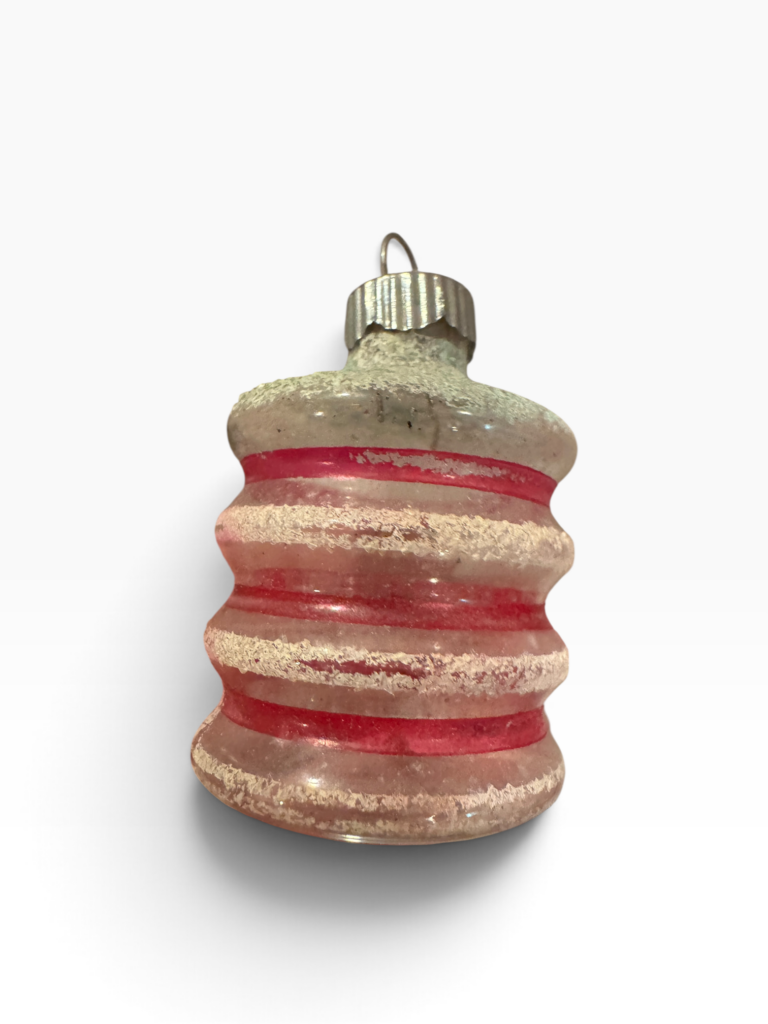
Shiny Brite ornaments appeared as bells, pine cones, teardrops, finials, icicles, lantern-like shapes, reflectors, and other molded forms.

Then World War II changed everything.

The Unsilvered Shiny Brite Ornaments of World War II

For collectors today, the wartime Shiny Brite ornaments are among the most historically fascinating.

They were created during a period when ordinary manufacturers had to adapt quickly to wartime restrictions.

Materials that had once been readily available for Christmas decorations suddenly had more important uses.

Metal was needed for military production.

Certain pigments and chemicals became difficult or impossible to obtain.

Even the materials that created the brilliant reflective interiors of glass ornaments became restricted.

And that is when Shiny Brite ornaments began looking very different.

When the “Shiny” Disappeared

One of the defining characteristics of a traditional Shiny Brite ornament is its mirrored interior.

However, during World War II, materials used in the silvering process became unavailable or heavily restricted.

The Henry Ford collection includes wartime Shiny Brite ornaments dated approximately 1942–1945 that were produced without the normal silvered interior. Their examples demonstrate how the company changed its decorating methods as wartime material restrictions intensified.

The result was the unsilvered ornament.

Instead of the brilliant mirrored appearance collectors associate with later Shiny Brites, these ornaments often have clear or translucent glass beneath their painted decoration.

Some appear almost transparent.

Others received light washes of color.

Still others feature simple stripes, stencils, or bands of opaque paint.

Because the reflective silver interior was missing, decorators had to create visual interest in other ways.

That necessity produced some wonderfully distinctive ornaments.

Stripes, Paint and Tinsel Replaced the Silver

One solution was remarkably simple: use more decoration on the outside.

Wartime ornaments often feature colorful stripes or painted bands. Red, green, pink, yellow, white, and other shades could create a bright effect even without an interior mirror coating.

Some unsilvered ornaments also received stenciled decoration.

Another clever technique involved placing a small piece or sprig of tinsel inside the clear ornament.

The tinsel caught the Christmas-tree lights and created at least some of the sparkle normally supplied by the silvered interior.

The practice has become one of the charming visual signatures of wartime American ornaments.

Today, collectors sometimes encounter these pieces and initially assume that the silvering has completely disappeared with age.

That certainly can happen to old ornaments.

But an important distinction exists:

Some Shiny Brite ornaments were never silvered in the first place.

Their clear interiors are not necessarily damage.

They can be evidence of wartime production.

Cardboard Caps: Another Wartime Clue

Silvering was not the only thing affected by wartime shortages.

Metal also became increasingly scarce for civilian products.

Early Shiny Brite ornaments typically used small metal caps and wire hangers. As wartime restrictions tightened, manufacturers began substituting other materials.

Cardboard and paper caps appeared.

String sometimes replaced wire.

The Henry Ford preserves Shiny Brite examples from approximately 1943–1945 with folded cardboard hangers and even combinations of cardboard, string, and glue.

These humble little fittings are now incredibly useful to collectors.

An unsilvered ornament combined with a wartime cardboard cap can provide strong evidence that an ornament dates from the World War II period.

The cap that once represented a manufacturing compromise has become part of the ornament’s historical importance.

American Made Became Part of the Story

World War II also changed how Shiny Brite marketed its ornaments.

Before the rise of domestic production, American Christmas trees were filled largely with imported European glass.

Now Shiny Brite could proudly emphasize something different:

American Made.

Original packaging frequently advertised the ornaments’ domestic manufacture. Some boxes even incorporated patriotic imagery.

The Henry Ford preserves wartime Shiny Brite packaging identifying the ornaments as American-made glass Christmas tree decorations.

That message carried enormous significance during the war.

Buying American-made Christmas ornaments was not simply convenient. It fit the larger national mood of self-sufficiency, patriotism, and support for American manufacturing.

A box of ornaments could quietly participate in that story.

After the War: The Shine Returns

When World War II ended in 1945, manufacturing restrictions gradually eased.

Metal caps returned.

So did silvering.

The reflective Shiny Brite look once again lived up fully to its name.

The Henry Ford dates examples with restored silver lacquer and metal caps to the postwar period beginning around 1946.

But Shiny Brite was no longer simply a wartime substitute for German ornaments.

It had become an American Christmas institution.

The late 1940s and 1950s brought tremendous growth in consumer culture. Families purchased new homes, new furniture, new appliances, and new Christmas decorations.

Holiday decorating became brighter and more coordinated.

Shiny Brite was perfectly positioned for that moment.

Christmas in Technicolor

The postwar years gave Shiny Brite an opportunity to become increasingly adventurous.

Traditional red and green remained popular, but ornament colors expanded dramatically.

Pink.

Turquoise.

Blue.

Gold.

Lavender.

Silver.

Pastels and intense jewel tones.

Striped ornaments became particularly recognizable. Some combined two or three colors. Others used snowy white painted decoration over brilliant reflective backgrounds.

Shapes also became more varied.

Round balls shared the tree with bells, teardrops, pine cones, lanterns, tops, reflectors and long finials.

A Christmas tree decorated entirely with Shiny Brite ornaments could become an explosion of color.

Shiny Brite and the Mid-Century Christmas Tree

By the 1950s, American Christmas decorating had embraced modern design.

This was the era of ranch houses, boomerang patterns, Formica kitchens, chrome, starbursts, new plastics, and brilliant colors.

Christmas decorations followed the same cultural shift.

The arrival of the aluminum Christmas tree created perhaps the perfect stage for colorful glass ornaments.

Against shimmering silver branches, pink, turquoise, blue, red, and green ornaments became almost theatrical.

A rotating color wheel could transform the entire tree.

Shiny Brite ornaments fit naturally into that new holiday aesthetic.

Yet they were equally at home on a traditional evergreen.

That versatility helped make them enormously popular.

The Boxes Matter Too

For collectors, the ornament is only part of the story.

Original Shiny Brite boxes can be fascinating historical objects in their own right.

Some held six ornaments.

Others held twelve.

Larger coordinated assortments offered families an instant decorating scheme.

Cardboard dividers kept the fragile glass separated, while brightly printed lids advertised the Shiny Brite name.

Today, an original box tells us things an individual ornament cannot.

It can help establish how ornaments were grouped.

It may show the original color assortment.

Labels can provide manufacturing information.

Graphics can help indicate a period.

And perhaps most importantly, a surviving box preserves the ornaments as a collection.

That matters.

Over the course of eighty years, Christmas ornaments tend to scatter.

One goes to a daughter.

Another goes to a grandson.

A few break.

Others disappear into different storage boxes.

Eventually the original group is lost.

That is why opening an old box and discovering a full or nearly full set can feel like opening a small time capsule.

Hand Decoration and the Beauty of Imperfection

Vintage Shiny Brite ornaments frequently reveal small variations.

A stripe may sit slightly higher on one ornament than another.

Paint thickness may vary.

A stencil may not land perfectly in the center.

Two ornaments from the same box may not look absolutely identical.

Those differences are part of their charm.

Although industrial machinery enabled the glass blanks to be created on a massive scale, much of the decorative work still involved human hands.

That marriage of machine production and hand decoration is one reason old Shiny Brites feel so different from many modern ornaments.

They are uniform enough to create a coordinated tree, yet imperfect enough to retain personality.

How Collectors Date Shiny Brite Ornaments

There is rarely one feature that dates every Shiny Brite perfectly.

Instead, collectors look at several clues together.

The cap is often important. Metal caps, cardboard caps, hook styles, and embossed markings can all offer evidence.

The ornament’s silvering matters as well.

Unsilvered glass combined with wartime-style fittings can suggest production during World War II.

Decoration offers another clue.

Certain colors, stencils, painted bands, shapes, and packaging styles became more common during particular periods.

Original boxes can be particularly helpful because graphics and manufacturing information changed over time.

However, vintage Christmas ornaments have often lived complicated lives.

Caps get replaced.

Sets get combined.

Ornaments migrate from one family box into another.

For that reason, dating should usually involve the entire object rather than one isolated feature.

Why Unsilvered Ornaments Deserve More Attention

For someone unfamiliar with wartime Christmas ornaments, an unsilvered example may initially appear less impressive than a brilliant mirrored Shiny Brite.

It may look faded.

Simple.

Perhaps even unfinished.

But once you understand why it looks that way, the ornament changes.

That clear glass becomes evidence of wartime restriction.

The thin painted stripes become evidence of ingenuity.

The cardboard cap becomes evidence of metal conservation.

The tinsel tucked inside becomes evidence of a decorator trying to create sparkle without the materials normally used to make it.

Suddenly, what appears to be the simplest ornament in the box may have the most interesting story.

That is one of the things that makes collecting vintage Christmas decorations so rewarding.

Beauty is only part of it.

History is often hiding in the details.

Shiny Brite Today

Decades after their original production, vintage Shiny Brite ornaments continue to appear in family collections, estate sales, antique shops, flea markets, and boxes tucked away in attics.

Some remain brilliant.

Others have softened beautifully with age.

Silvering may have mottled.

Paint may have faded.

Metal caps may have darkened.

Boxes may carry handwritten names or old price markings.

Collectors often value those signs of age rather than trying to erase them.

They remind us that these objects were never created to sit behind glass.

They were created to celebrate Christmas.

Families handled them.

Children helped hang them.

They reflected tree lights in living rooms that looked very different from ours.

Then, every January, someone carefully wrapped them and put them away until another Christmas arrived.

More Than a Christmas Ornament

Perhaps that is why Shiny Brite remains so beloved.

These ornaments tell several American stories at once.

They tell the story of an immigrant businessman who saw that the American ornament trade needed to change.

They tell the story of Corning engineers transforming lightbulb machinery into an extraordinary system for producing Christmas decorations.

They tell the story of wartime factories improvising when familiar materials disappeared.

They tell the story of postwar America embracing color, abundance, modern design, and a new vision of Christmas.

And sometimes they tell a much smaller story.

A little painted ornament survives because someone loved it enough to wrap it in tissue paper for eighty Christmases.

That may be the best part of the Shiny Brite story.

The company made ornaments by the millions.

Yet today, when we hold one in our hands, each somehow feels personal.