How one remarkable family—and the extraordinary artists who surrounded them—helped shape one of the most influential movements in the history of decorative arts.
Introduction
Imagine walking through Paris in 1900.
Every street seems alive with change. Hector Guimard is transforming the entrances to the Paris Métro into twisting stems of cast iron that appear to grow from the earth itself. Louis Majorelle is designing furniture whose graceful forms resemble flowering trees rather than cabinets and tables. Émile Gallé captures dragonflies, orchids, and moonlit landscapes within molten glass, while René Lalique reimagines jewelry through sculptural combinations of enamel, horn, ivory, and precious gemstones. Everywhere one looks, artists are abandoning rigid Victorian traditions in favor of nature, movement, and imagination.
Amid this extraordinary explosion of creativity, one ceramic artist quietly emerged as a bridge between sculpture, architecture, glassmaking, and the decorative arts. His name was Edmond Lachenal.
Today, Lachenal is remembered as one of the most accomplished ceramic artists of the French Art Nouveau movement, celebrated for his innovative glazes, sculptural forms, and willingness to challenge the conventions of nineteenth-century pottery. Yet reducing him to simply a master ceramicist tells only part of the story. His greatest contribution was not merely the beautiful objects he created, but the creative world in which he worked—a world where painters exchanged ideas with architects, sculptors collaborated with metalworkers, glassmakers inspired furniture designers, and the boundaries separating the decorative arts all but disappeared.
It was an extraordinary period in history when artists no longer viewed ceramics, glass, ironwork, wood, bronze, or jewelry as isolated disciplines. Instead, they believed every artistic medium should speak the same visual language. A vase could possess the elegance of sculpture. A chandelier could become architecture suspended from a ceiling. A cabinet could appear to grow like a living tree, while a ceramic vessel might be transformed into a complete work of art through the addition of hand-forged iron or finely cast bronze.
At the heart of this creative revolution stood Edmond Lachenal. Trained by one of France’s most celebrated ceramic innovators, surrounded by visionary designers, and exhibiting alongside some of the defining names of the Belle Époque, Lachenal became part of an artistic network whose influence extended far beyond the walls of his own workshop. His career intersected with many of the figures who would define Art Nouveau, and his work reflected the movement’s belief that beauty should be woven into every aspect of everyday life.
This is not simply the story of one remarkable ceramic artist. It is the story of a family whose artistic legacy spanned generations, the remarkable circle of craftsmen and designers who inspired one another, and a moment in history when Paris became the creative capital of the world. It is a story of experimentation, collaboration, and the pursuit of beauty—a philosophy that continues to captivate collectors, museums, and admirers more than a century later.
The Lachenal Legacy Begins
Long before the name Edmond Lachenal became synonymous with French Art Nouveau ceramics, it belonged to a family whose livelihood and identity were deeply rooted in the ancient craft of pottery. Like many artistic families of nineteenth-century France, the Lachenals understood that mastery could not be learned overnight. It was earned through years of observation, discipline, and an intimate understanding of materials that were as unpredictable as they were beautiful.
At the center of this tradition was Claude Lachenal, Edmond’s father. Although history has largely remembered his son as the family’s most celebrated artist, Claude played an indispensable role in shaping what would become one of France’s most influential ceramic dynasties. He represented an earlier generation of craftsmen whose knowledge was built upon centuries of French pottery traditions—where the wheel, the kiln, and the chemistry of clay were respected as much as any painter’s brush or sculptor’s chisel. Every great artistic legacy begins with someone whose name history often overlooks. For the Lachenal family, that foundation was Claude Lachenal, a skilled French potter whose workshop became the birthplace of one of the most celebrated ceramic dynasties of the Art Nouveau period.
Although relatively little documentation survives about Claude’s personal life or professional career, his influence can be measured through the extraordinary accomplishments of the generations that followed. Like many nineteenth-century French craftsmen, Claude belonged to a tradition in which artistic knowledge was not learned from textbooks or formal lectures, but through years of practical experience. The workshop was both studio and classroom, where every stage of production—from selecting clay and preparing glazes to firing the kiln—was mastered through patience, observation, and repetition.
During the mid-nineteenth century, French ceramics occupied an interesting place within the decorative arts. While porcelain factories and regional pottery workshops produced objects of exceptional quality, ceramics were still largely regarded as an artisan’s craft rather than an equal to painting or sculpture. Master potters such as Claude preserved techniques that had been refined over generations, emphasizing careful workmanship, technical precision, and an intimate understanding of the unpredictable nature of clay and fire.
It was within this environment that the next generation of the Lachenal family was raised. Surrounded by wheels, kilns, and freshly thrown vessels, young Edmond Lachenal absorbed the rhythms of the workshop almost from birth. Before he ever studied under renowned ceramic master Théodore Deck or exhibited alongside the leading artists of the Belle Époque, he first learned the discipline, patience, and respect for craftsmanship that only a family workshop could provide.
Claude Lachenal may never have achieved the international recognition later enjoyed by his son, yet his contribution should not be underestimated. The artistic confidence that allowed Edmond to challenge convention and help redefine French ceramics was built upon the technical foundation his father provided. In many ways, Claude represents the quiet beginning of a story that would eventually influence the course of French decorative arts.
For a young Edmond, the workshop was more than a place of employment. It was his classroom.
There he learned that clay possessed a memory of every hand that touched it. A vessel was not simply thrown on a wheel; it was coaxed into existence through patience, precision, and an understanding that every stage—from shaping and drying to glazing and firing—could determine success or failure. Long before he ever entered one of Paris’s celebrated ateliers, Edmond was absorbing lessons that could never be taught in an academy.
Yet the France into which Edmond matured was changing rapidly.
The Industrial Revolution had transformed manufacturing, making decorative objects more affordable than ever before. Factories were capable of producing thousands of identical pieces, but many artists feared something essential was being lost. The individuality of the craftsman—the subtle variations that revealed a human hand—was disappearing beneath mechanical perfection.
For ambitious young artists, this changing world posed an important question.
Would ceramics remain a traditional craft, or could they become a respected fine art?
Edmond Lachenal would spend his career answering that question.
Unlike many artisans who were content to preserve established traditions, he possessed an insatiable curiosity. The technical knowledge inherited from his father provided a remarkable foundation, but it was only the beginning. Edmond sought opportunities beyond the family workshop, eager to study with the greatest ceramic innovators of his generation and to discover how clay might become a medium capable of expressing the same emotion, movement, and originality found in painting and sculpture.
That decision would alter not only the course of his own life, but also the future of French decorative arts.
Within a few short years, the young potter who had learned the fundamentals in his father’s workshop would find himself apprenticed to one of the most influential ceramic artists in Europe. Under the guidance of Théodore Deck, Edmond Lachenal would encounter revolutionary glazing techniques, artistic experimentation, and an entirely new vision for what ceramics could become.
The lessons he carried from his family home would never be abandoned. Instead, they would become the strong roots from which an entirely new artistic language would grow.
Edmond Lachenal: A New Vision for French Ceramics
When Edmond Lachenal was born in 1855, France was a nation caught between tradition and innovation. Decorative arts were flourishing, yet many ceramic workshops still relied on established forms and centuries-old techniques that left little room for artistic experimentation. While craftsmanship remained highly respected, pottery was often viewed as a decorative craft rather than a serious artistic medium.
Lachenal saw something different.
Raised in a family where clay was both a livelihood and a way of life, he inherited an appreciation for technical excellence from an early age. But unlike many young craftsmen who were content to continue established traditions, Edmond possessed an uncommon curiosity. He wanted to understand not only how ceramics were made, but how they could evolve. He was fascinated by the endless possibilities hidden within clay, glaze, texture, and color—possibilities that could transform a simple vessel into an expressive work of art.
This restless spirit defined his career.
Throughout the second half of the nineteenth century, Europe was experiencing an artistic awakening. Japanese ceramics, newly introduced to Western audiences through international exhibitions and expanding trade, challenged long-held European ideas about decoration and form. At the same time, artists across France were questioning the rigid historicism of previous generations. Rather than copying the past, they sought inspiration from the natural world—flowers bending in the wind, insects resting on reeds, vines climbing stone walls, and the ever-changing colors of the landscape.
Lachenal found himself perfectly suited to this new way of thinking.
His work gradually departed from the formal symmetry and heavy ornamentation that had characterized much nineteenth-century decorative art. Instead, his ceramics embraced movement and spontaneity. Surfaces became canvases for richly layered glazes whose colors flowed unpredictably during firing. Forms softened into graceful silhouettes that echoed seed pods, blossoms, and flowing water. No two pieces were ever entirely alike, because Lachenal welcomed the kiln as a creative partner rather than merely a tool of production.
This willingness to experiment distinguished him from many of his contemporaries. Every firing carried an element of uncertainty, and that uncertainty became part of the beauty. Rather than striving for mechanical perfection, Lachenal celebrated the subtle variations that only handcrafted ceramics could achieve. The depth of an oxblood glaze, the delicate transition between green and amber, or the crystalline bloom that emerged unexpectedly from the intense heat of the kiln transformed each object into something singular.
Yet technical innovation alone does not explain why Edmond Lachenal remains so highly regarded today.
What truly set him apart was his belief that ceramics belonged alongside painting, sculpture, architecture, and fine furniture as equal expressions of artistic creativity. His vessels were never conceived as mere containers. They were sculptural compositions designed to evoke emotion as much as function. Every curve, every glaze, and every carefully considered proportion reflected a broader artistic philosophy that beauty should enrich everyday life.
It was a philosophy shared by many of the visionary artists who would come to define the Art Nouveau movement, but before Edmond Lachenal could become one of its leading voices, he sought guidance from a man whose influence on French ceramics would prove immeasurable.
That man was Théodore Deck.
Learning from a Master: Théodore Deck
For a young Edmond Lachenal, there could hardly have been a more influential mentor. By the time Lachenal entered Deck’s atelier, Théodore Deck had already established himself as one of France’s most innovative ceramic artists, celebrated not only for his technical brilliance but for his relentless willingness to challenge convention. At a time when many potters faithfully reproduced historical styles, Deck looked toward the future. His workshop became a laboratory where chemistry, artistry, and imagination merged in pursuit of entirely new possibilities.
Born in 1823 in Guebwiller, Alsace, Deck trained as a stove maker before turning his attention to ceramics, a decision that would forever change the course of French decorative arts. His fascination with Islamic ceramics, Renaissance maiolica, and East Asian pottery inspired him to experiment with glazes unlike anything Europe had seen in centuries. Most famous among these discoveries was the brilliant turquoise glaze now universally known as “Bleu Deck,” a luminous color that captivated collectors and fellow artists alike. Yet Deck’s greatest achievement was not a single glaze or decorative technique. It was his conviction that ceramics deserved to stand alongside painting and sculpture as one of the highest forms of artistic expression.
For Edmond Lachenal, this was a revelation.
The disciplined craftsmanship he had learned in his father’s workshop suddenly met a world of artistic freedom. Under Deck’s guidance, clay became more than a material to be shaped—it became a canvas for experimentation. Glazes were no longer simply protective finishes but expressive elements capable of creating depth, movement, and emotion. Every firing offered an opportunity for discovery, and every unexpected result invited further exploration rather than disappointment.
Deck’s studio was unlike the traditional workshops of earlier generations. It attracted painters, sculptors, designers, architects, and collectors who believed the decorative arts were entering a new era. Ideas flowed as freely as clay passed through skilled hands. Historical techniques were studied with great respect, yet no one felt bound by them. Innovation was encouraged, experimentation celebrated, and artistic curiosity rewarded.
It was within this remarkable environment that Edmond Lachenal developed the confidence to move beyond technical mastery and embrace creative risk. He observed firsthand that the greatest artists were not content to imitate the past; they sought to interpret nature through their own imagination. Organic forms replaced rigid symmetry. Rich experimental glazes transformed simple vessels into luminous sculptures. Function and beauty became inseparable.
Perhaps the greatest lesson Lachenal carried away from Théodore Deck’s atelier was that true craftsmanship is never static. Every generation has both the privilege and the responsibility to build upon the knowledge of those who came before. Deck had challenged the accepted boundaries of ceramics, and his young apprentice would soon carry that spirit of innovation even further.
As Edmond Lachenal’s reputation began to grow, so too did the remarkable circle of artists surrounding him. Sculptors, architects, glassmakers, furniture designers, and master metalworkers were all searching for a common artistic language—one inspired not by history, but by the beauty and vitality of the natural world. Together, they would become the creative force we now know as Art Nouveau.
Among Giants: The Artists Who Shaped a Movement
No great artist creates in isolation.
While Edmond Lachenal was developing his distinctive voice as a ceramic artist, Paris was experiencing one of the most extraordinary periods of artistic collaboration in its history. The closing decades of the nineteenth century witnessed an unprecedented exchange of ideas among painters, sculptors, architects, glassmakers, cabinetmakers, metalworkers, and ceramicists. Workshops became places of experimentation rather than simple production, and artists frequently looked beyond their own disciplines in search of inspiration.
Rather than competing with one another, many of these remarkable creators shared a common ambition—to erase the boundaries that had traditionally separated the fine arts from the decorative arts. A vase could possess the elegance of sculpture. A cabinet might resemble a living tree. A piece of jewelry could become a miniature work of architecture. Together they sought to create objects that were not merely useful, but beautiful expressions of nature, craftsmanship, and imagination.
For Edmond Lachenal, this creative environment proved transformative. His career placed him among some of the most influential artistic minds of the Belle Époque, individuals whose innovations would forever change the appearance of homes, galleries, museums, and international exhibitions. Each approached Art Nouveau through a different medium, yet all shared the belief that beauty should flow naturally through every aspect of daily life.
Ernest Chaplet: The Fearless Experimenter
If Théodore Deck taught Edmond Lachenal that ceramics could become fine art, Ernest Chaplet demonstrated that experimentation itself could be an artistic philosophy.
Chaplet was among the most adventurous ceramicists of nineteenth-century France. Fascinated by chemistry, kiln atmospheres, and the unpredictable behavior of glazes, he constantly pushed beyond accepted techniques in search of entirely new effects. Rather than fearing failure, he embraced it, understanding that many of the most beautiful discoveries in ceramics emerged through curiosity and persistence.
Lachenal found in Chaplet a kindred spirit. Both artists believed that no two works should be identical, and both welcomed the subtle variations that only the kiln could produce. Their vessels celebrated flowing glazes, organic forms, and the spontaneity that distinguished handmade ceramics from factory production. In many respects, Chaplet helped reinforce the idea that the artist should work with the unpredictable nature of fire rather than attempt to dominate it.
This philosophy would become one of the defining characteristics of French Art Nouveau ceramics.
Émile Gallé: Nature Preserved in Glass
While Lachenal explored the expressive possibilities of clay, Émile Gallé was transforming molten glass into poetry.
Few artists captured the spirit of Art Nouveau more completely than Gallé. His vases and vessels shimmered with layered landscapes, dragonflies, orchids, water lilies, and forests illuminated by changing light. Like Lachenal, Gallé rejected historical ornament in favor of direct observation of the natural world. Plants were no longer decorative motifs—they became living subjects worthy of careful study.
Although each worked in a different material, their artistic philosophies were remarkably similar. Both believed that nature should guide design rather than merely decorate it. The flowing silhouettes, rich color palettes, and organic movement found in Lachenal’s ceramics echoed the same ideals that made Gallé one of the most celebrated glass artists of his generation.
Together they demonstrated that whether working in clay or glass, Art Nouveau was united by a shared visual language rather than a single medium.
Louis Majorelle: Sculpting Nature in Wood
If Émile Gallé gave Art Nouveau its poetic voice in glass, Louis Majorelle transformed that same philosophy into furniture. A master cabinetmaker and designer from Nancy, Majorelle rejected the heavy, rigid forms of earlier furniture in favor of graceful silhouettes inspired by the natural world. His tables, cabinets, and beds seemed almost alive, their legs resembling twisting branches and their carved details echoing lilies, orchids, dragonflies, and climbing vines.
Majorelle believed that furniture should do more than furnish a room—it should contribute to its artistic harmony. Every surface, every curve, and every carefully selected material reflected a commitment to craftsmanship that paralleled Edmond Lachenal’s own approach to ceramics. Neither artist viewed function and beauty as opposing ideas. Instead, they believed useful objects could become works of art without sacrificing their purpose.
Although they worked in different mediums, both men were responding to the same cultural movement. The flowing lines seen in Majorelle’s carved walnut are mirrored in the elegant profiles of Lachenal’s ceramic vessels, each drawing inspiration from the rhythms and asymmetry of nature rather than the rigid geometry of earlier decorative styles. Their work reminds us that Art Nouveau was never confined to a single discipline; it was a shared artistic language spoken through wood, clay, glass, and metal alike.
René Lalique: Transforming Jewelry into Sculpture
Perhaps no artist better demonstrated Art Nouveau’s rejection of convention than René Lalique. At a time when jewelers measured value primarily by the size of gemstones, Lalique believed that imagination and artistic design mattered far more than expensive materials. Horn, enamel, glass, ivory, and semi-precious stones became as important to him as diamonds and emeralds.
His jewelry often featured dragonflies, peacocks, orchids, serpents, and mysterious female figures emerging from nature itself. Rather than simply decorating the human body, his creations became miniature sculptures that celebrated movement, symbolism, and craftsmanship.
This philosophy resonated deeply with the work of Edmond Lachenal. Both artists challenged traditional expectations within their respective fields. Lalique questioned what fine jewelry could become, while Lachenal asked the same question of ceramics. In both cases, artistic expression replaced convention, and beauty became the highest measure of success.
Their work exemplifies one of the defining principles of Art Nouveau: that every object, regardless of its function or material, deserved the same thoughtful attention to design and artistic integrity.
Hector Guimard: Architecture Comes Alive
While Lachenal shaped clay and Lalique transformed precious materials into wearable art, Hector Guimard reimagined the very streets of Paris.
Today he is best remembered for the iconic entrances to the Paris Métro, where cast iron curves into elegant stems, leaves, and blossoms that appear to grow organically from the sidewalks. Yet Guimard’s vision extended far beyond transportation. He designed homes, furniture, lighting, hardware, and interiors as unified artistic environments in which every detail contributed to a harmonious whole.
This concept of the Gesamtkunstwerk—the “total work of art”—was embraced by many of the leading figures of the Art Nouveau movement. Rather than treating architecture, furniture, lighting, ceramics, and decorative objects as separate disciplines, artists sought to create complete environments where each element complemented the others.
Edmond Lachenal shared this philosophy. His ceramics were never intended merely as containers or ornaments. Their sculptural forms invited conversation with the spaces they occupied, reflecting the same organic principles that guided Guimard’s architecture. Whether expressed in iron, stone, or clay, both artists sought to blur the distinction between the natural world and the objects that surrounded everyday life.
Collaboration as an Art Form
One of the most remarkable aspects of the Art Nouveau movement was its collaborative spirit. Unlike many artistic periods in which individual achievement dominated public attention, the Belle Époque fostered an environment where designers, sculptors, metalworkers, ceramicists, architects, and glassmakers frequently worked together to create unified works of art.
Edmond Lachenal embraced this collaborative philosophy throughout his career. He produced ceramics from designs by sculptors, worked alongside artists exploring new decorative techniques, and continually exchanged ideas with contemporaries whose talents lay beyond the potter’s wheel. These collaborations enriched his own work while contributing to the broader evolution of French decorative arts.
Among the craftsmen who embodied this spirit was Louis Katona, whose mastery of hand-forged Beaux-Arts ironwork transformed ceramic vessels into complete artistic compositions. Rather than serving merely as structural supports, Katona’s forged mounts became integral parts of the design, extending the flowing lines of the ceramic forms into graceful iron vines, stems, and botanical motifs. His work perfectly reflected the Art Nouveau belief that every material—whether clay, iron, glass, or wood—could contribute equally to the beauty of the finished object.
It is through collaborations like these that we gain a deeper appreciation for Edmond Lachenal’s artistic vision. He understood that great art need not exist within the boundaries of a single craft. Instead, the finest creations emerged when gifted artisans combined their individual talents to produce works of lasting beauty and remarkable harmony.
The Next Generation: Raoul Lachenal and a Legacy Reimagined
The story of the Lachenal family did not end with Edmond.
By the opening years of the twentieth century, the world that had made Edmond Lachenal’s career possible was beginning to change. Art Nouveau had transformed the decorative arts, but its flowering lines, botanical imagery, and poetic surfaces were gradually giving way to new tastes. The First World War would alter Europe profoundly. Architecture became cleaner and more geometric. Luxury objects became bolder, sleeker, and more modern. The next generation of artists faced a difficult but exhilarating challenge: how could they honor the achievements of the past without becoming trapped within them?
For Edmond’s son, Raoul Lachenal, that question was deeply personal.
Raoul grew up surrounded by ceramics, artistry, experimentation, and the daily life of a celebrated workshop. He worked in his father’s studio and came of age within the same rarefied world of French decorative arts that had shaped Edmond. Yet he was not simply a caretaker of an established name. Like his father before him, Raoul developed his own voice, gradually adapting the Lachenal tradition to the changing visual language of the twentieth century.
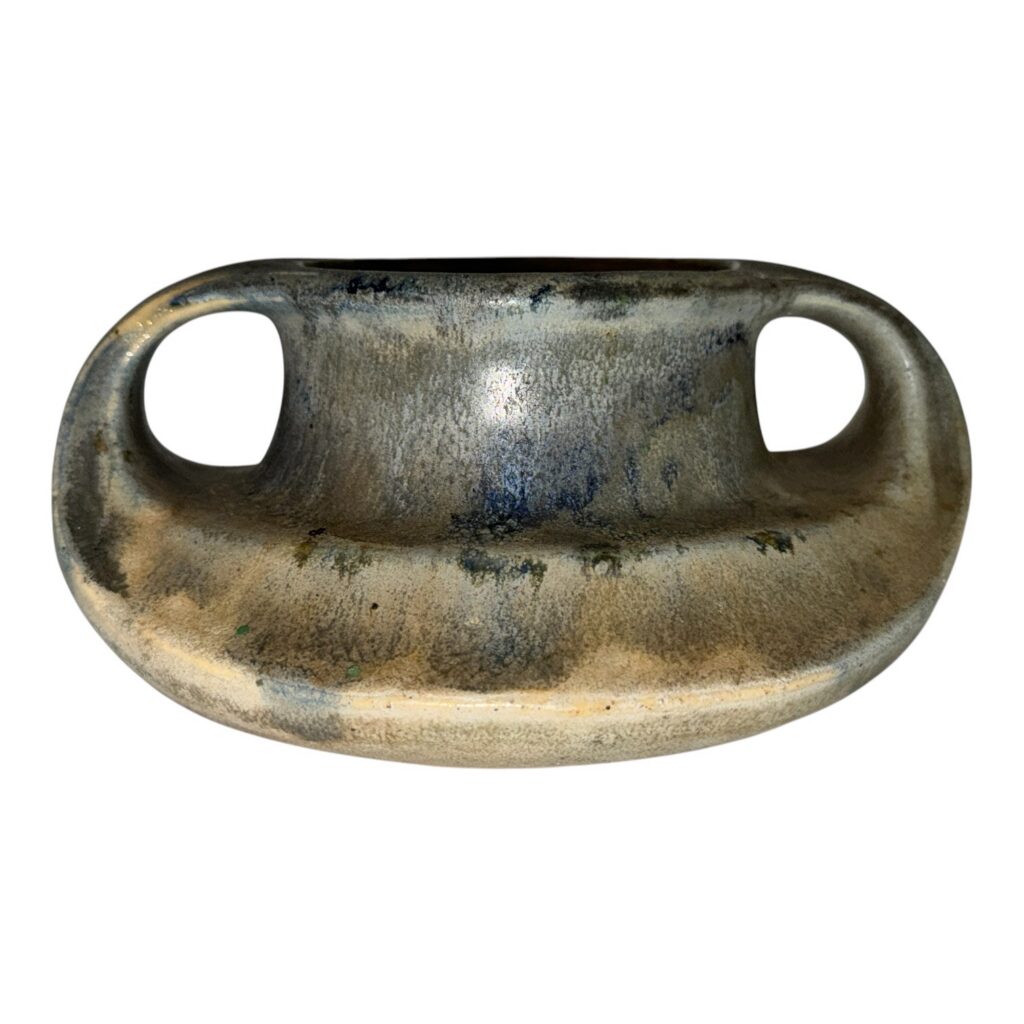
His earliest work naturally reveals the influence of the family atelier. Collectors may encounter stoneware with organic forms, looping handles, sculptural surfaces, and incised decoration that recalls the expressive vocabulary of late Art Nouveau. These pieces can feel very close to Edmond’s work, not because Raoul lacked originality, but because father and son shared a workshop, techniques, materials, and an artistic environment during a period when collaboration and influence often overlapped.
That closeness is one of the reasons attribution can be so complicated today.
A collector studying a Lachenal vessel may be looking at the work of Edmond, the work of Raoul, a workshop production, or an object shaped by the artistic interchange of both men. Auction descriptions sometimes oversimplify these distinctions, especially when a piece carries the Lachenal name but lacks an easily read signature, date, or documented exhibition history. For serious collectors, this is not a minor technical issue. It is part of the fascination of the family’s legacy.
The Lachenal name represents more than a single artist. It represents a living atelier tradition in which ideas evolved across generations.
Raoul eventually established his own workshop, taking the family story into a new era. His work increasingly reflected the changing tastes of the early twentieth century, moving away from the most overtly naturalistic forms of Art Nouveau and toward stronger decorative structure, bolder color relationships, and a more modern understanding of surface design. In this sense, he became an important bridge between his father’s generation and the coming age of Art Deco.
The shift is subtle but meaningful. Edmond Lachenal’s work often feels rooted in the sensuality of the natural world: leaves, insects, flowers, flowing glazes, and sculptural forms that appear to have grown rather than been manufactured. Raoul retained the respect for material, individuality, and ceramic experimentation that defined the family workshop, but he belonged to a generation increasingly drawn to line, rhythm, stylization, and modernity.
That evolution allowed the Lachenal legacy to remain relevant.
Rather than preserving his father’s style unchanged, Raoul demonstrated that a great artistic inheritance should be carried forward, tested, and transformed. He maintained the family reputation for high-quality French ceramics while proving that a workshop tradition could survive changing fashions without losing its identity.
For collectors, that makes Raoul Lachenal far more than “Edmond’s son.” He is an artist in his own right—and a crucial figure in understanding how French ceramics moved from the final flowering of Art Nouveau toward the bold new language of Art Deco.
The Lachenal family story, then, is not a single brilliant chapter followed by an echo. It is a conversation across generations: Claude’s foundation of craftsmanship, Edmond’s artistic revolution, and Raoul’s ability to carry that inheritance into a changing century.
Why Collectors Continue to Pursue Edmond Lachenal
More than a century after his death, Edmond Lachenal remains one of the most sought-after names in French Art Nouveau ceramics. His work appears regularly at leading international auction houses, is represented in major museum collections, and continues to attract collectors who appreciate not only beautiful objects but the remarkable artistic story behind them.
Part of that enduring appeal lies in Lachenal’s willingness to take risks.
Unlike many ceramic manufacturers of the late nineteenth century, whose workshops emphasized consistency and repetition, Lachenal embraced experimentation. Every firing presented an opportunity to discover new glaze effects, richer colors, and more expressive surfaces. His celebrated oxblood reds, luminous crystalline glazes, iridescent finishes, and subtle matte textures were not accidents of production—they were the result of years of technical exploration and an unwavering commitment to artistic innovation.
Equally important was his belief that ceramics deserved the same respect as painting, sculpture, and architecture. Rather than producing vessels that merely served a practical function, Lachenal created sculptural forms that stood comfortably alongside the finest decorative arts of his generation. Bamboo, lilies, dragonflies, seed pods, flowing stems, and organic silhouettes transformed familiar objects into artistic statements inspired directly by nature.
Recognition came during his own lifetime.
Lachenal exhibited at the great international expositions that celebrated the artistic achievements of the Belle Époque, including the 1889 Exposition Universelle in Paris, where he was awarded a Gold Medal for his ceramic work. That exposition, held to commemorate the centennial of the French Revolution, also introduced the world to the newly completed Eiffel Tower. To receive one of its highest honors placed Lachenal among the leading decorative artists of his era. He later exhibited at the 1900 Exposition Universelle, another landmark event that showcased the very best of French art, design, and craftsmanship to an international audience.
His reputation extended well beyond the world’s fairs. Lachenal became a regular exhibitor at the Salon de la Société Nationale des Beaux-Arts, where many of France’s foremost painters, sculptors, architects, and decorative artists presented their newest work. Participation in the Salon reflected the growing recognition that ceramics had earned a place among the highest artistic disciplines rather than remaining merely decorative craft.
Today, museums continue to affirm that legacy. Examples of Edmond Lachenal’s work reside in distinguished public collections, including the Petit Palais – Musée des Beaux-Arts de la Ville de Paris, the Musée d’Orsay, and other institutions devoted to preserving the achievements of French decorative arts. Their presence in these collections reflects not simply historical importance but extraordinary artistic quality.
Collectors also appreciate the individuality of his work. Unlike factory production, no two Lachenal pieces are ever truly identical. Variations in firing temperature, glaze chemistry, hand modeling, and sculptural decoration ensure that each object possesses its own personality. Even when similar forms appear, subtle differences remind us that these works were created by artists rather than machines.
Perhaps most importantly, Edmond Lachenal occupies a unique place in the history of ceramics. He stood at the crossroads of tradition and innovation—trained within the discipline of nineteenth-century craftsmanship yet fearless in his pursuit of new artistic possibilities. His collaborations with sculptors, architects, and decorative metalworkers further blurred the boundaries between the fine and decorative arts, creating objects that remain as compelling today as they were at the height of the Art Nouveau movement.
For today’s collectors, acquiring an Edmond Lachenal work is about far more than owning a beautiful ceramic object. It is an opportunity to preserve a piece of one of the most creative periods in French artistic history—a time when imagination, craftsmanship, and innovation combined to redefine what decorative art could become.
A Masterpiece of Collaboration
Throughout the Art Nouveau movement, artists sought to erase the boundaries between individual disciplines. A ceramic vessel might become sculpture. Iron could flow like vines through a garden. Glass captured the changing colors of nature, while furniture and architecture became part of a unified artistic vision. The greatest achievements of the Belle Époque were rarely the result of a single craft. They emerged when extraordinary artists combined their talents in pursuit of something greater than any one medium could achieve alone.
Among the finest surviving examples of this philosophy is the remarkable lamp that inspired this article.
Created around the turn of the twentieth century, it unites the celebrated ceramic artistry of Edmond Lachenal with the exceptional decorative ironwork of Louis Katona. Together they produced an object that embodies nearly every ideal explored throughout these pages: technical innovation, sculptural beauty, master craftsmanship, and the seamless integration of multiple artistic disciplines.
A Legacy That Continues
The Art Nouveau movement lasted only a few decades, yet its influence continues to inspire artists, collectors, historians, and museums around the world. Few ceramicists embody that remarkable period more completely than Edmond Lachenal. His willingness to experiment, his collaborations with some of the finest artists and craftsmen of his generation, and his unwavering belief that ceramics deserved a place among the highest forms of artistic expression helped redefine the possibilities of decorative art.
Today, more than a century after his workshop fell silent, Lachenal’s work continues to captivate a new generation of collectors. Whether encountered in a museum gallery, a private collection, or an auction catalogue, his ceramics remind us that true craftsmanship transcends fashion. They represent an era when beauty, innovation, and technical mastery existed in perfect harmony.
The remarkable lamp that inspired this article is but one surviving example of that legacy. Whether it resides in a private collection, a museum, or eventually finds a new steward, its story remains part of the larger history of French decorative arts. The object may change hands, but the artistry, the craftsmanship, and the history it represents belong to all who seek to understand and appreciate this extraordinary period.
It is my hope that this article serves not simply as a study of one exceptional work, but as an invitation to explore the remarkable world of Edmond Lachenal, his family, his contemporaries, and the artists who transformed clay, iron, glass, and wood into enduring works of art. Their legacy continues to shape our understanding of Art Nouveau and reminds us that the greatest decorative arts are never merely decorative—they are lasting expressions of human creativity.
As Art & Beautiful Things continues to grow, I look forward to sharing more stories like this one. Whether exploring a newly discovered masterpiece, tracing the history of an overlooked artist, or examining the craftsmanship behind extraordinary objects, these articles are intended to preserve and celebrate the rich history of the decorative arts for collectors, scholars, and anyone with a curiosity for beautiful things.
Because while great works of art may eventually leave our hands, their stories deserve to endure.
 (248) 617-7717
 mona@artandbeautifulthings.com