(248) 617-7717
 mona@artandbeautifulthings.com




- 80s
- Art
- Abstract
- Art Deco
- Atomic
- Brutalist
- Ceramics & Pottery
- China & Porcelain
- Collectibles
- Decor
- Delightfully Kitschy
- Fashion
- Folk
- Fun
- Furniture
- Glass
- Gothic
- Holiday
- Historical Significance
- Hollywood Regency
- Industrial
- Kitchen
- Lighting
- Metal
- Mid Century
- Mid Century Modern
- Modern
- Off The Wall
- Old World
- Pop Art
- Primitive
- Rustic
- Salvage
- The Beauty Of Asia
- The Beauty of All Europe
- The Beauty of Canada
- The Beauty of France
- The Beauty of Italy
- The Beauty of Scandinavia
- The Beauty of the UK
- The Classics
- Whimsical
Vintage Heidt Christmas Ornaments: History, Identification & Rare American Glass

Some vintage Christmas ornaments announce themselves immediately.
A familiar Shiny Brite cap may give away the maker. An original box may identify George Franke, Premier Glass Works, Paragon, or Santa Novelties. Other ornaments are much more elusive.
Then there are Heidt Christmas ornaments.
Among collectors of early American glass Christmas decorations, the Heidt name carries an almost legendary quality. The ornaments associated with Heidt can be extraordinary: deeply molded glass, dramatic double indents, elaborate floral patterns, unusual textured surfaces, pine cones, teardrops, grape clusters, and remarkably long glass necks.
Yet the history of Heidt is not nearly as well known as that of Shiny Brite.
Even experienced collectors sometimes disagree over attribution.
Was a particular ornament made by Heidt? Premier? Corning? Was it imported from Germany? Was the cap replaced decades ago?
Those questions are part of what makes Heidt ornaments so fascinating.
Their story sits at the intersection of Old World glassmaking traditions and the emerging American Christmas ornament industry of the 1930s and 1940s.
Who Was Henry Heidt?
The surviving documentation identifies Henry Heidt with an ornament decorating factory in Baltimore, Maryland.
A published history of the American glass ornament industry includes a period photograph captioned “Decorating at the Henry Heidt Factory, Baltimore, Maryland.” The same historical account discusses Heidt alongside other American ornament decorators who worked with glass blanks produced by Corning.
That detail matters because a different story has circulated widely among collectors and online sellers.
According to that version, a German ornament maker named Heidt fled Europe, settled in New York, produced ornaments for a short period, and later returned to Germany.
That story has been repeated frequently in the vintage marketplace. However, readily available documentation supporting every part of that biography is difficult to find.
What can be established with much greater confidence is that Heidt was part of the American glass Christmas ornament industry and operated a decorating factory in Baltimore.
America Begins Making Its Own Glass Ornaments
To understand Heidt, it helps to understand what was happening in American Christmas manufacturing.
Before the late 1930s, the United States imported enormous quantities of glass Christmas ornaments from Europe, particularly Germany.
German glassmakers had generations of experience producing delicate blown-glass Christmas decorations. American consumers became accustomed to their bright silvered balls, molded forms, indents, fruit shapes, pine cones, and elaborate decorative effects.
Then the political situation in Europe changed.
Imports became increasingly uncertain.
American manufacturers began looking for ways to produce Christmas ornaments domestically.
One company would prove essential to that transformation:
Corning Glass Works.
Corning Changes the American Christmas Ornament Industry
Corning already had machinery designed to manufacture glass light bulbs on a massive scale.
Engineers realized that similar machinery could produce thin glass Christmas ornament blanks.
That innovation changed the American ornament industry.
Instead of relying entirely on European glassblowers, American decorating companies could purchase enormous quantities of domestically produced glass blanks.
The ornaments could then be silvered, painted, stenciled, striped, screened, and packaged by different American firms.
Historical research on the Heidt factory specifically notes that the bulbs being decorated there were produced by Corning.
This helps explain one of the greatest challenges in identifying early American ornaments today.
Several competing companies could begin with similar—or even identical—glass blanks.
The difference came later.
Decoration.
Cap style.
Packaging.
Painting.
Screen printing.
And sometimes the particular shapes commissioned or used by a manufacturer.
Heidt Was Part of a Larger American Ornament Network
It is tempting to imagine every ornament company blowing its own glass, decorating it, adding caps, boxing it, and shipping it from one factory.
The reality was often more complicated.
Corning supplied blanks to numerous companies.
Different firms decorated those blanks.
Other companies supplied caps and packaging.
Some businesses produced specialized glass forms while using standard blanks for other products.
A modern collector may therefore encounter two ornaments with nearly identical shapes but completely different original manufacturers.
This is why attribution requires care.
A generic silver ball cannot simply be called Shiny Brite because it looks like one.
Likewise, an elaborate bumpy indent cannot automatically be called Heidt simply because similar examples have been attributed to Heidt.
What Do Heidt Ornaments Look Like?
This is where Heidt becomes much more recognizable.
Collectors associate the name with some of the most elaborate American glass forms from the prewar and early wartime period.
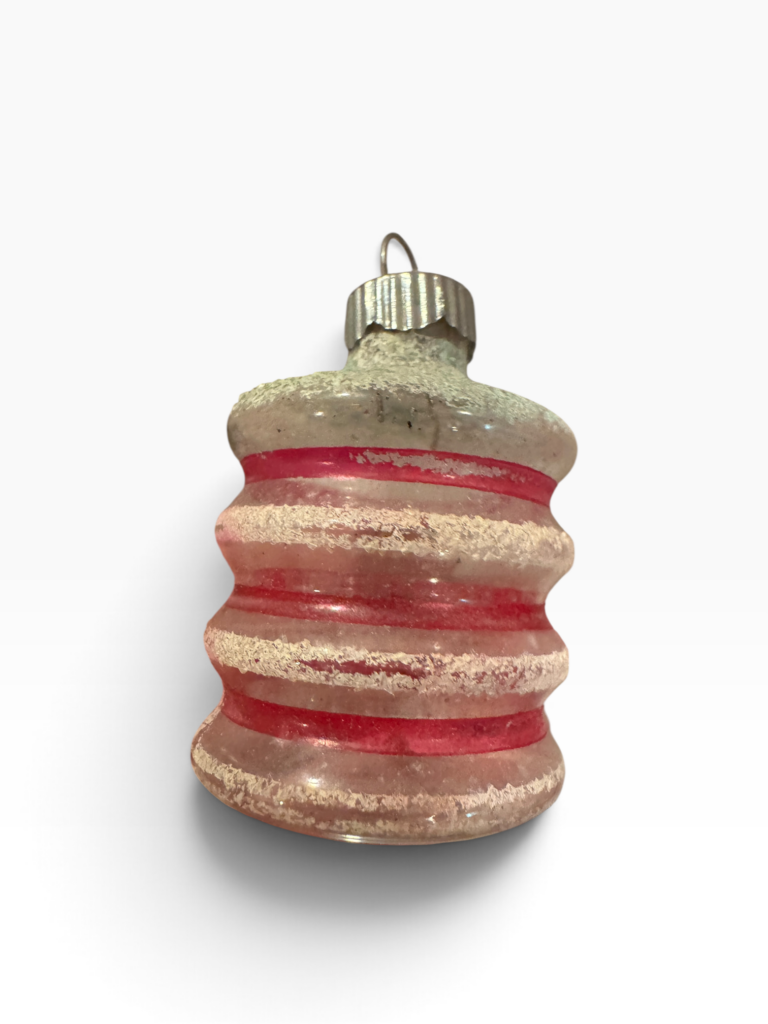
Known examples include deeply embossed floral forms, double-sided star indents, heavily textured or “bumpy” surfaces, pine-cone shapes, elongated teardrops, wreath-like patterns, grape-cluster forms, and large molded ornaments with multiple geometric elements.
These ornaments often look noticeably different from the simpler round glass balls that dominated later mass-market production.
There is more architecture to them.
More relief.
More shadow.
The glass itself becomes part of the decoration.
The Beauty of Deeply Molded Glass
One of the most striking characteristics associated with Heidt is the use of deeply molded surfaces.
Imagine a simple round Christmas ball.
Light reflects across a relatively smooth surface.
Now imagine that same glass covered with raised berries, ribs, leaves, diamonds, petals, or star-shaped depressions.
Suddenly the ornament becomes sculptural.
Light breaks across dozens of tiny planes.
Silvering emphasizes some areas while painted details highlight others.
On an illuminated Christmas tree, the ornament changes constantly as the viewer moves around it.
That is one reason early molded glass ornaments remain so visually compelling.
They were tiny pieces of decorative glasswork.
The Famous Heidt “Bumpy” Ornaments
Collectors frequently use the word bumpy when describing ornaments attributed to Heidt.
It is not a technical glassmaking term so much as an instantly understandable collector description.
The surfaces may feature dozens of raised rounded forms.
Some resemble berries.
Others create a textured border around a central indent.
In certain examples, those bumps surround a dramatic star-shaped depression in the center.
One documented style combines a bumpy exterior with star indents on both sides. Another uses complex floral or radial patterns framed by raised glass decoration.
These forms can be extraordinarily beautiful.
They also explain why collectors sometimes mistake them for European ornaments.
Their complexity looks very different from the simplest machine-produced American balls.
Double Indents
Indented Christmas ornaments have always fascinated collectors.
The glass is pushed inward to create a recessed area that catches and reflects light.
In simple examples, there may be one central indent.
More elaborate ornaments can have geometric designs, starbursts, flowers, or multiple layers of indentation.
Some Heidt-attributed ornaments feature double indents, meaning decorative indents appear on both sides.
Specialist examples include pine cones and teardrops with deeply molded six-pointed or multipointed star indents on opposing sides.
That complexity required much more elaborate glass forming than an ordinary round ball.
It also creates tremendous visual depth.
The Long Pike: An Important Collector Clue
One feature appears repeatedly in collector descriptions of Heidt ornaments:
an unusually long pike.
The pike is the narrow glass neck at the top of the ornament.
After an ornament was blown or formed, that neck provided an opening for silvering and finishing. A cap eventually covered the top portion of it.
On some Heidt-attributed ornaments, the pike extends noticeably farther than on similar ornaments associated with Premier or other American manufacturers.
Collectors therefore sometimes use the long pike as an identifying characteristic.
However, it should be treated as a clue rather than an absolute rule.
One characteristic alone rarely proves an attribution.
The Cap Question
Vintage ornament collectors learn quickly:
Never trust a cap completely.
Caps fall off.
Families replace them.
Children mix them up.
Collectors restore incomplete ornaments.
Loose caps accumulate at the bottom of boxes and eventually find their way onto another ornament.
After eighty or ninety years, an ornament may easily wear a cap it did not leave the factory with.
That issue becomes particularly important with Heidt and Premier.
Specialist examples of Heidt-attributed ornaments appear with unmarked caps, sawtooth-style caps, and occasionally even Premier-marked caps.
Does that mean Premier made the ornament?
Perhaps.
Or perhaps the cap moved.
Without original packaging or strong provenance, certainty may be impossible.
That uncertainty is not a weakness in collecting.
It is simply part of working with old objects.
Why Heidt and Premier Are So Often Confused
If you begin researching Heidt ornaments, one name appears almost immediately:
Premier Glass Works.
Collectors regularly confuse the two.
That makes sense.
Both companies participated in the early American glass ornament industry.
Both are associated with unusually elaborate forms.
Both produced ornaments during roughly overlapping periods.
And the ornaments have spent approximately eight decades moving between boxes and collections.
Specialist dealers repeatedly note that certain Heidt-attributed double indents and molded ornaments are often mistaken for Premier examples.
In some cases, even knowledgeable collectors continue debating particular molds.
That is why careful wording matters.
When identification depends solely on shape, “attributed to Heidt” can sometimes be more accurate than stating with certainty that an ornament was made by Heidt.
American Made, but with European Roots
Heidt ornaments occupy an interesting place in design history.
They look European.
That is understandable.
The emerging American Christmas ornament industry was heavily influenced by European glassmaking.
Many immigrant craftspeople brought European techniques, aesthetic traditions, and manufacturing knowledge with them.
American companies were not designing Christmas ornaments in a cultural vacuum.
They were adapting an established European tradition to American industrial production.
Heidt ornaments illustrate that transition beautifully.
An ornament could be made or decorated in America yet still retain the elaborate molded forms associated with European Christmas glass.
Before “Shiny Brite” Became a Generic Description
Today, many people casually refer to almost any vintage American glass Christmas ball as a Shiny Brite.
Collectors know that is not accurate.
Shiny Brite was a specific brand.
Other American companies included Premier, George Franke Sons, Coby, Marks Brothers, Paragon, Santa Novelties, North American Glass, Heidt, and others.
The confusion is understandable because so many companies used Corning blanks.
Similarities among the ornament blanks eventually encouraged consumers to use “Shiny Brite” almost generically for American glass Christmas balls.
But learning the individual companies reveals a much richer story.
There was never just one American ornament maker.
There was an entire industry.
Decoration at the Henry Heidt Factory
One especially interesting surviving glimpse of Heidt comes from the decorating process itself.
A documented photograph of the Henry Heidt Factory in Baltimore shows an ornament decorating operation using screen-based technology.
The process allowed designs to be applied around much of the circumference of an ornament, although the extreme top and bottom remained undecorated because the screen could not make contact with those areas.
This represents another important stage in American ornament history.
Christmas ornaments were becoming more industrialized.
Yet decoration remained a complex combination of machinery and hand labor.
Even during the 1950s, American factories continued hand decorating certain stripes, stars, dots, bells, and other designs.
The transition from handcraft to mass production was not instantaneous.
For years, both methods existed side by side.
Why Original Boxes Are So Important
For a company as poorly documented in the popular market as Heidt, original packaging becomes particularly valuable.
An ornament alone may suggest an attribution.
A labeled box can transform that attribution into documentation.
Unfortunately, boxes disappear much faster than ornaments.
Families often transferred fragile glass decorations into larger storage boxes.
Cardboard deteriorated.
Labels came loose.
Sets became mixed.
When the original packaging disappeared, the manufacturer’s identity often disappeared with it.
That is why vintage ornament collectors sometimes value a battered original box far more than a noncollector might expect.
The box is evidence.
Dating Heidt Ornaments
Many ornaments attributed to Heidt are generally placed in the 1930s through early 1940s.
Specialist examples frequently date ornate molded pieces to the mid- or late 1930s.
As always, collectors should be cautious about assigning an exact year without packaging or documentary evidence.
Several features can help:
The shape of the glass.
The length of the pike.
The construction of the cap.
The silvering.
The color palette.
The decorating method.
The presence of a pontil.
And ideally, an original box.
Those details should be considered together.
Mouth-Blown or Machine Made?
This question deserves special care.
Certain elaborate Heidt-attributed pieces show evidence consistent with mouth-blown production, including surviving pontil marks.
At the same time, documented later Heidt production involved Corning-manufactured blanks.
That means not every Heidt ornament should be assumed to come from one production method.
The company existed during a transitional period.
Some forms may reflect older glassblowing traditions.
Others clearly belong to the expanding American system of machine-made Corning blanks and specialized decorating factories.
That mix may be one of the most interesting things about Heidt.
When Identification Becomes Detective Work
Suppose you find a large vintage glass ornament.
It has a deeply molded surface.
There are star indents on both sides.
The neck is unusually long.
The cap is unmarked.
The form resembles known Heidt examples.
Is it Heidt?
Possibly.
Now suppose the same ornament has a Premier cap.
Is it Premier?
Perhaps.
Or perhaps someone changed the cap in 1958.
Or 1975.
Or last Christmas.
That is why serious collecting often resembles detective work.
You compare shapes.
Study boxes.
Look at old catalogs.
Examine caps.
Compare decoration.
Consider manufacturing methods.
And sometimes the most responsible conclusion is simply:
Probably Heidt.
There is nothing wrong with uncertainty when the evidence is incomplete.
Why Heidt Ornaments Are Scarce Today
Heidt never became a household name like Shiny Brite.
That alone makes identification harder.
The production period associated with the most elaborate Heidt ornaments also appears relatively early in the development of the American glass ornament industry.
Then there is the unavoidable problem of survival.
Thin glass does not age easily.
Large ornaments break.
Long pikes snap.
Deep indents create delicate structural areas.
Silvering deteriorates.
Paint wears.
Boxes disappear.
Every Christmas season adds another opportunity for an ornament to fall from a branch.
The fact that these elaborate early pieces survive at all is remarkable.
The Appeal of Imperfection
Collectors sometimes become overly concerned about finding perfectly preserved vintage ornaments.
Yet the beauty of early glass often lies partly in its age.
A little silver loss reveals the transparent glass beneath.
A faded painted star shows where a brush once passed across the surface.
Oxidation creates mottled areas.
A small variation between two supposedly matching ornaments reminds us that people participated in their manufacture.
An eighty-year-old ornament does not need to look new to remain beautiful.
In many cases, its imperfections are part of the historical record.
Heidt in the Larger Story of American Christmas
The importance of Heidt goes beyond rarity.
These ornaments help explain how America developed its own Christmas decoration industry.
The story was not simply that Germany stopped shipping ornaments and Shiny Brite took over.
The reality was much richer.
Corning developed the ability to manufacture glass blanks on an extraordinary scale.
Decorators and manufacturers across the country transformed those blanks into competing products.
German and other European immigrants contributed skills and aesthetic traditions.
Companies experimented with printing, hand painting, silvering, molding, coloring, and packaging.
Some became famous.
Others vanished.
Heidt belongs to that second group.
Yet the ornaments remained.
Why Collectors Should Know the Heidt Name
There is something particularly satisfying about recognizing an object that most people would overlook.
Someone may see an old glass ornament.
A collector sees the long pike.
Then the double indent.
Then the deeply molded berries.
Then the unusual geometry.
Suddenly the ornament deserves a second look.
That is what knowledge does.
It transforms an old Christmas decoration into an artifact.
And that is why Heidt deserves a place alongside Shiny Brite, Premier, Franke, Paragon, Coby, and Santa Novelties when we tell the story of American Christmas ornaments.
The Mystery Is Part of the Magic
Perhaps Heidt ornaments would be less interesting if everything about them were neatly documented.
Instead, they invite questions.
Who designed this mold?
Who decorated it?
Was this shape made exclusively for Heidt?
Did this cap originally belong here?
Was this ornament blown individually or produced from a Corning blank?
Why does this one have such an extraordinarily long neck?
Collectors may continue debating some of those questions for years.
That is part of the pleasure.
Christmas ornaments were never intended to become historical documents.
They were decorations.
They were handled by children.
Stored in attics.
Passed through families.
Mixed into different boxes.
Hung from thousands of trees.
Nobody imagined that generations later someone would study the shape of a glass neck or the teeth around a metal cap to determine who made it.
And yet here we are.
The companies may be gone.
The factories may have disappeared.
But their fragile glass creations remain.
Sometimes all it takes is one unusual ornament hanging on a tree to bring the story back to life.