 (248) 617-7717
 mona@artandbeautifulthings.com




- 80s
- Art
- Abstract
- Art Deco
- Atomic
- Brutalist
- Ceramics & Pottery
- China & Porcelain
- Collectibles
- Decor
- Delightfully Kitschy
- Fashion
- Folk
- Fun
- Furniture
- Glass
- Gothic
- Holiday
- Historical Significance
- Hollywood Regency
- Industrial
- Kitchen
- Lighting
- Metal
- Mid Century
- Mid Century Modern
- Modern
- Off The Wall
- Old World
- Pop Art
- Primitive
- Rustic
- Salvage
- The Beauty Of Asia
- The Beauty of All Europe
- The Beauty of Canada
- The Beauty of France
- The Beauty of Italy
- The Beauty of Scandinavia
- The Beauty of the UK
- The Classics
- Whimsical
John Gerletti and the American Studio Glass Movement: When Glass Became Art

An exploration of artistic freedom, molten glass, and the extraordinary transformation of an ancient craft into a modern American art form.
The Beauty of Glass Beyond the Ordinary
There is something almost magical about watching light pass through a beautifully crafted piece of art glass. Colors awaken, shadows deepen, and delicate patterns emerge from within the transparent material. Unlike paintings or sculptures fashioned from stone, glass possesses an extraordinary ability to interact with its surroundings. It can capture the brilliance of sunlight, reflect the warmth of a room, and transform even the simplest shape into something unexpectedly beautiful.
For centuries, skilled glassmakers created remarkable objects that balanced usefulness with decoration. Elegant Venetian goblets, richly colored Bohemian vessels, and the luminous creations of American glasshouses demonstrated the remarkable possibilities of the medium. Yet much of this production remained connected to established workshops, factories, and commercial enterprises.
During the twentieth century, a new generation of artists began questioning these traditions. What if glass could become something more personal? What if an artist could work independently, experimenting with color, texture, and sculptural form without the limitations of commercial production?
Those questions helped inspire one of the most important developments in modern decorative arts: the American Studio Glass Movement.
Among the artists whose work reflects the creative possibilities of this movement is California glassmaker John Gerletti, whose expressive vessels transform an ancient material into compositions of extraordinary color and movement.
A Revolution Begins in the American Midwest
The story of American studio glass begins not in the celebrated glassmaking centers of Venice or Bohemia, but in the American Midwest.
In the years following World War II, American artists increasingly explored traditional craft materials as vehicles for personal expression. Ceramics, textiles, metalwork, and woodworking began moving beyond their familiar functional roles, gaining recognition as independent artistic disciplines.
Glass, however, presented an unusual challenge.
Unlike clay, which an artist could shape in a modest pottery studio, molten glass required specialized furnaces capable of maintaining extremely high temperatures. The expense and complexity of this equipment meant that glassmaking generally remained concentrated in factories and established production workshops.
For an independent artist, the practical difficulties were enormous.
One individual who believed these limitations could be overcome was Harvey K. Littleton.
Born in 1922 in Corning, New York, Littleton grew up surrounded by the industrial glassmaking world. His father worked in research at Corning Glass Works, giving the young Littleton an unusual familiarity with glass technology and production.
Despite this background, Littleton initially pursued ceramics rather than glass.
He studied industrial design at the University of Michigan and subsequently attended the prestigious Cranbrook Academy of Art in Bloomfield Hills, Michigan, where he earned his graduate degree in 1951.
Cranbrook’s philosophy of integrating art, design, and craftsmanship helped shape an American design culture that valued experimentation and individual artistic expression.
Littleton later joined the faculty of the University of Wisconsin, where his interests increasingly returned to the possibilities of glass.
He believed artists should be able to work directly with molten glass, just as ceramic artists worked with clay.
It was a deceptively simple idea that would fundamentally change American glassmaking.
Toledo, Ohio, 1962: The Birth of a Movement
In 1962, Littleton collaborated with glass scientist Dominick Labino to conduct experimental workshops at the Toledo Museum of Art in Ohio.
Their objective was to demonstrate that glass could be melted, gathered, and shaped using equipment small enough for an independent artist’s studio.
Labino contributed crucial technical knowledge, including glass compositions that could melt at lower temperatures than those commonly used in industrial production.
Together, these innovations helped make small-scale artistic glassblowing practical.
The workshops introduced artists to the possibilities of working directly with molten glass. Participants explored techniques, experimented with equipment, and began developing new approaches to a material traditionally associated with industrial manufacturing.
The results were not immediately polished masterpieces.
Early studio glass pieces could be irregular, experimental, and technically imperfect. Yet their importance lay in something far greater than their appearance.
They demonstrated that glassmaking could become an independent artistic practice.
The Corning Museum of Glass recognizes the 1962 workshops as foundational events in the American Studio Glass Movement. The museum’s historical collections preserve objects and documentation associated with these remarkable experiments.
Within a few years, university glass programs and independent studios began developing across the United States, introducing a generation of artists to the creative possibilities of molten glass.
When the Vessel Became a Sculpture
As studio glass developed during the 1960s and 1970s, artists increasingly challenged traditional definitions of what glass objects should be.
A bowl no longer needed to function primarily as a container. A vase could become an abstract composition. A sculptural form might retain the suggestion of a familiar vessel while abandoning conventional symmetry altogether.
This transformation represented an important departure from traditional production glass.
Factories typically valued consistency, repeatability, and commercial practicality. Independent studio artists could instead emphasize experimentation, spontaneity, and individual expression.
Glass became a medium through which artists could investigate movement, transparency, color, and the relationship between interior and exterior space.
Among the artists who helped expand these possibilities were Dale Chihuly, Marvin Lipofsky, and Tom Patti.
Their work demonstrated that glass could occupy the same artistic territory as painting and sculpture while retaining the distinctive optical qualities that make the material so extraordinary.
The Smithsonian American Art Museum’s Renwick Gallery has played an important role in presenting studio glass as an independent artistic discipline. Its exhibitions and collections document the movement’s transformation from experimental craft practice into a significant field of contemporary art.
John Gerletti: An Artist Working with Color and Movement
Within this broader tradition of independent glassmaking, John Gerletti developed an approach characterized by richly decorated surfaces and expressive sculptural forms.
Gerletti is associated with Ventura, California, where he and fellow glass artist Suzi Perret have operated a working studio.
Information published by the gallery Flower and Hewes describes their practice as combining surface decoration with the physical manipulation of molten glass.
Their approach emphasizes creating individual pieces rather than producing identical objects.
The gallery describes large undulating centerpieces, platters, bowls, vessels, and other sculptural forms among their specialties.
This combination of decorative complexity and dramatic shaping gives Gerletti’s work a distinctive visual personality.
His vessels frequently appear to exist somewhere between traditional functional glassware and independent sculpture.
The familiar outline of a bowl or vase provides the starting point, but sweeping curves, irregular silhouettes, and colorful abstract decoration transform the object into something more expressive.
The glass itself becomes an active participant in the composition.
Light passes through transparent sections, illuminating colors and revealing overlapping decorative elements. Curved surfaces distort and magnify patterns, creating the impression that the imagery is moving within the vessel.
Although publicly available biographical information about Gerletti is relatively limited, documented examples of his work and descriptions of his studio practice establish his connection to the continuing tradition of American studio glass.
The Art of Controlling Molten Glass
To appreciate a sculptural glass vessel, it helps to understand the extraordinary demands of working with molten glass.
Glassblowing requires a combination of technical knowledge, physical coordination, artistic judgment, and precise timing.
The glassmaker begins by gathering molten glass onto the end of a blowpipe. Through controlled rotation, blowing, reheating, and manipulation, the artist gradually develops the desired form.
Unlike clay, which can remain workable for an extended period, hot glass continually changes as it cools.
The artist must repeatedly return the piece to a reheating furnace while maintaining control over its shape.
Creating a large vessel with an elaborate undulating rim introduces additional challenges.
As the glass softens, gravity influences its movement. The artist must control the relationship between heat, thickness, and the distribution of the material.
The flowing curves of a ruffled bowl may appear effortless, yet they represent a careful balance between deliberate shaping and the natural behavior of molten glass.
Color adds another dimension of complexity.
Colored glass can be incorporated through several techniques, including layering, applying colored fragments, and introducing decorative elements during the forming process.
The exact methods used in an individual work cannot always be determined through photographs alone.
Nevertheless, the finished object reveals the glassmaker’s ability to combine technical control with artistic imagination.
In the most successful studio glass, the complexity of the process disappears behind the apparent spontaneity of the finished form.
A Remarkable John Gerletti Bowl from 1990
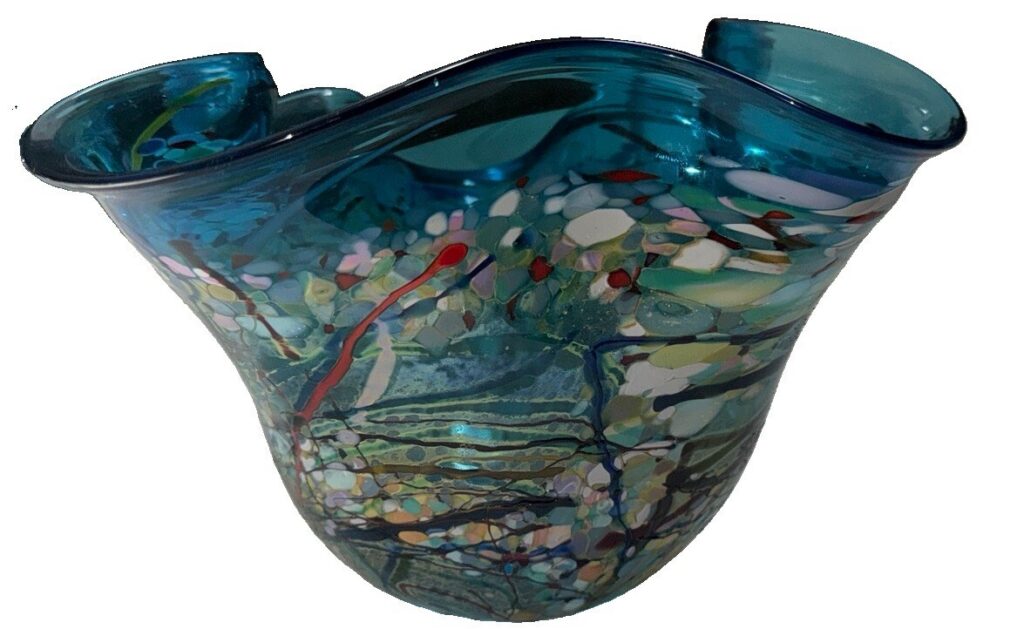
Among the beautiful objects preserved by Art & Beautiful Things is a large hand-blown art glass bowl signed John Gerletti and dated 1990.
This remarkable vessel captures many of the qualities that make late twentieth-century American studio glass so appealing.
Its most immediately striking feature is the dramatic ruffled rim.
Rather than following the predictable circular outline of a conventional bowl, the glass rises and falls in sweeping, asymmetrical curves. The undulating silhouette suggests the movement of water, the unfolding petals of a flower, or a piece of fabric suspended in motion.
Brilliant turquoise and aquamarine glass dominate the upper portion of the vessel.
The luminous blue rim creates a graceful visual boundary while allowing light to penetrate the transparent glass.
Beneath this flowing edge, an intricate composition of colors unfolds.
Soft lavender, pale pink, emerald green, golden yellow, and brilliant blue appear among irregular, mosaic-like decorative elements. Delicate dark lines extend across the surface, suggesting branches, stems, or the abstract outlines of a landscape.
The decoration possesses a painterly quality.
Viewed from different angles, the overlapping colors and transparent surfaces create changing visual relationships. What initially appears to be a collection of colorful fragments gradually develops into a richly layered abstract composition.
The relationship between the sculptural rim and the decorated body is particularly compelling.
The rim introduces movement and rhythm, while the intricate surface decoration encourages closer examination.
Together, they create a vessel that rewards both distant appreciation and intimate observation.
Signed and dated 1990, the bowl belongs to a period when American studio glass had already developed a substantial artistic identity.
Nearly three decades had passed since the pioneering Toledo workshops.
By this time, glass artists were working in independent studios, exhibiting in galleries, and exploring increasingly ambitious approaches to form and decoration.
Gerletti’s bowl reflects the freedom made possible by that earlier revolution.
It remains recognizable as a bowl, yet its visual importance lies in its sculptural presence rather than its practical function.
The vessel becomes an artwork in its own right.
California and the Continuing Studio Glass Tradition
Although the American Studio Glass Movement emerged from experiments in the Midwest, its influence quickly spread across the country.
California became an important environment for artists exploring unconventional materials and expressive forms.
The state’s broader artistic culture encouraged experimentation across painting, sculpture, ceramics, and glass.
Within this atmosphere, studio glass offered artists opportunities to combine technical craftsmanship with an increasingly personal artistic vocabulary.
Gerletti’s association with Ventura places his work within this continuing tradition of independent California glassmaking.
A visitor guide published by Visit Ventura identifies Ventura Hot Glass as a working studio associated with Gerletti and Suzi Perret.
Their practice illustrates an essential characteristic of the studio glass movement: the close relationship between the artist, the material, and the finished object.
Rather than relying on anonymous industrial production, the independent glassmaker participates directly in the creation of the work.
Every stage of the process contributes to its individuality.
The finished vessel carries evidence of artistic decisions made while the glass was hot, fluid, and responsive to the maker’s movements.
Why Signed Studio Glass Matters
For collectors, a signed and dated studio glass vessel offers a particularly meaningful connection to its maker.
The signature identifies the artist associated with the work, while the date places the object within a specific moment in the artist’s career.
These details can help establish provenance, support historical research, and distinguish individually created studio pieces from anonymous commercial production.
However, a signature alone does not determine artistic importance or market value.
Collectors also consider condition, quality of execution, scale, visual appeal, documented exhibition history, and the artist’s broader reputation.
In the case of Gerletti’s 1990 bowl, the signature and date provide an important starting point for understanding the object.
Its artistic qualities, however, are immediately visible.
The extraordinary color combinations, elaborate decoration, and dramatic sculptural silhouette demonstrate the expressive possibilities of hand-blown glass.
It is precisely this combination of craftsmanship and individuality that makes studio glass such a fascinating collecting field.
Preserving the Legacy of American Studio Glass
More than sixty years after the groundbreaking experiments in Toledo, American studio glass continues to occupy an important place in the history of modern decorative arts.
What began as an effort to make glassblowing accessible to individual artists developed into an international movement that expanded the boundaries of sculpture, design, and contemporary craft.
The achievements of Harvey Littleton, Dominick Labino, and the generations of artists who followed transformed the way glass could be created and appreciated.
Their legacy can be seen in museums, galleries, private collections, and independent studios throughout the world.
John Gerletti’s work belongs to this continuing artistic conversation.
His expressive vessels demonstrate how an ancient material can be transformed through contemporary imagination.
The remarkable 1990 bowl preserved by Art & Beautiful Things offers a beautiful example of that transformation.
Its luminous turquoise glass, richly colored abstract decoration, and sweeping sculptural form invite viewers to experience glass not simply as a decorative material, but as a medium capable of extraordinary artistic expression.
And perhaps that is the enduring beauty of the American Studio Glass Movement.
It gave artists the freedom to transform molten glass into something deeply personal.
Something unexpected.
Something beautiful.
Research References
The following sources provide historical documentation and additional information about the American Studio Glass Movement and John Gerletti.
Corning Museum of Glass — Studio Glass Movement
A museum definition explaining the origins and defining characteristics of independent studio glassmaking.
Smithsonian American Art Museum — Harvey K. Littleton
Biographical information documenting Littleton’s education, including his Michigan connections, and his contributions to American studio glass.
Corning Museum of Glass — The 1962 Toledo Workshops
Historical information about Harvey Littleton, Dominick Labino, and the experimental workshops that helped establish the movement.
Smithsonian Archives of American Art — 1962 Glass Workshop Report
An archival record documenting the objectives and activities of the Toledo workshops.
Smithsonian American Art Museum — New Glass Then
An examination of important artists and developments in the American studio glass tradition.
Flower and Hewes — John Gerletti
Gallery information describing Gerletti’s studio practice, collaboration with Suzi Perret, and sculptural glass forms.
Visit Ventura — Arts and Culture
Local documentation identifying Ventura Hot Glass as a working studio associated with Gerletti and Perret.