 (248) 617-7717
 mona@artandbeautifulthings.com




- 80s
- Art
- Abstract
- Art Deco
- Atomic
- Brutalist
- Ceramics & Pottery
- China & Porcelain
- Collectibles
- Decor
- Delightfully Kitschy
- Fashion
- Folk
- Fun
- Furniture
- Glass
- Gothic
- Holiday
- Historical Significance
- Hollywood Regency
- Industrial
- Kitchen
- Lighting
- Metal
- Mid Century
- Mid Century Modern
- Modern
- Off The Wall
- Old World
- Pop Art
- Primitive
- Rustic
- Salvage
- The Beauty Of Asia
- The Beauty of All Europe
- The Beauty of Canada
- The Beauty of France
- The Beauty of Italy
- The Beauty of Scandinavia
- The Beauty of the UK
- The Classics
- Whimsical
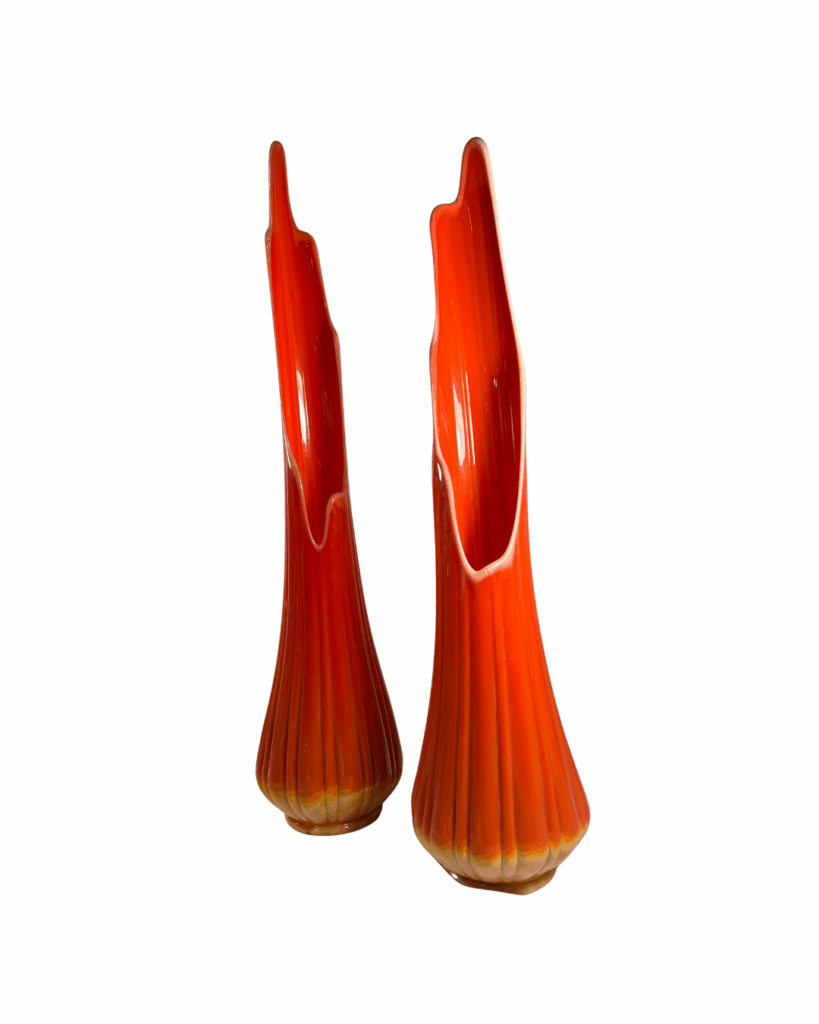
Vintage Swung Glass Vases: The Art, History, and Drama of Mid-Century Glass

There is something almost theatrical about vintage swung glass vases. They rise from a table in long, fluid forms, twisting and stretching upward as if the glass were still moving. Some end in sharp points, while others flare into soft petals. Many seem to lean, curve, or pull away from themselves. That sense of motion is part of what makes swung glass so memorable. Unlike a conventional vase, which usually follows a more predictable shape, swung glass often feels more like sculpture. The best examples use height, color, and asymmetry to create drama, and flowers are almost unnecessary because the vase itself becomes the focal point.
What Is Swung Glass?
The term “swung glass” generally refers to the way certain glass forms were elongated while the material was still hot and workable. A vase could begin as a shorter molded or hand-formed piece, and while the glass remained hot, the maker manipulated and extended it. Gravity helped pull and stretch the form, which is one reason two examples of the same general design may not end up exactly the same height. One may be taller than another, while a rim may flare differently or lean more noticeably to one side. These differences are not flaws. They are often part of the process itself, and that individuality is one of the great pleasures of collecting swung glass.
Why Swung Glass Feels So Modern
Mid-century design celebrated movement, experimentation, and bold visual statements, and swung glass fit perfectly into that world. Designers were moving away from heavy ornament and toward expressive form. Instead of relying on engraving, cutting, or painted decoration, the object itself became the design. A tall swung vase might have a compact base, a narrow stretched neck, and a wildly irregular opening. Another might taper into several points or petals. The glass could feel organic, almost botanical. In some examples, the silhouette resembles a flame. In others, it suggests leaves, flower petals, or flowing fabric. This is part of the reason swung glass still feels contemporary today. The shapes were modern then, and many still look modern now.
West Virginia and the American Glass Tradition
The story of American swung glass is closely connected to West Virginia, which became one of the most important centers of glass production in the United States. The region offered natural resources, fuel, transportation, and skilled workers, and over time companies such as Fenton, Blenko, Pilgrim, and Viking became closely associated with West Virginia glassmaking. The state produced everything from practical household glass to highly decorative art glass. By the middle of the 20th century, manufacturers increasingly competed through design. Color became bolder, forms became more expressive, and decorative glass began to take on a more sculptural quality. That shift created the perfect environment for swung glass.
Viking Glass and New Martinsville
No discussion of swung glass is complete without mentioning Viking Glass. The company grew out of the New Martinsville Glass tradition in New Martinsville, West Virginia, and by the mid-20th century Viking had developed a strong identity built around colorful decorative glass. The company became especially known for dramatic forms, saturated color, and sculptural vases. These pieces could be elegant, flamboyant, or wildly expressive, and Viking did not simply make tall glass. It made glass that seemed designed to dominate a room. That quality helped establish the company as one of the names collectors now associate most strongly with vintage swung glass.
The Importance of Viking Epic Glass
One of Viking’s most important mid-century lines was the Epic line. Introduced during the late 1950s, Epic reflected the company’s growing interest in bold sculptural form. The line included many different shapes, and tall vases became some of its most visually striking pieces. Over time, Viking expanded the series with pulled rims, petal forms, and increasingly dramatic silhouettes. Some pieces reached impressive heights, while others used wide bases and narrow necks to create exaggerated proportions. The effect was unmistakably modern. These objects were not meant to disappear into the background. They were designed to be seen.
Color Was Just as Important as Shape
Viking understood that color could transform a simple silhouette into something extraordinary. Collectors today still respond strongly to the company’s rich oranges, reds, ambers, blues, and greens. Some colors appear almost molten, while others deepen dramatically in shadow. A tall vase can look entirely different depending on where it sits. Near a window, the upper portion may glow, while the thicker base can appear darker and more concentrated. This relationship between color and thickness gives swung glass a sense of depth that photographs often struggle to capture, and it is one reason these pieces are so striking in person.
Orange, red-orange, and persimmon tones are among the most visually powerful swung glass colors. These shades became closely associated with mid-century interiors and worked beautifully with walnut furniture, brass accents, earthy ceramics, and bold textiles. Even today, orange swung glass has remarkable decorative impact. It can feel glamorous in a modern interior, warm in a traditional room, or dramatic in an autumn display. That versatility helps explain why collectors continue to seek it.
Viking Was Not the Only Maker
Collectors should still be careful with attribution because not every tall, colorful swung vase is Viking. That is one of the most common mistakes in the vintage glass market. Many American and European glass companies experimented with pulled, stretched, or elongated forms, so a vase may look “Viking-like” without actually being Viking. Firm attribution should rely on more than shape alone. Base treatment, color, rim form, documented catalog shapes, and known production details all matter. This is especially important because Viking’s popularity can encourage over-attribution. At Art & Beautiful Things, we prefer to leave a piece unattributed when the evidence is uncertain. A beautiful vase does not need a famous name to be important.
What Collectors Look For
Condition matters greatly in swung glass because the very features that make these vases beautiful also make them vulnerable. Tall necks can chip, sharp rim points can break, and flared edges can suffer small impacts. Because of that, collectors often inspect the rim first. The base also deserves attention, especially for grinding, scratches, chips, or repairs. At the same time, not every bubble or irregularity should be treated as damage. Vintage glass often contains small production characteristics, and minor bubbles, slight asymmetry, and tooling marks may simply reflect the way the piece was made. Understanding the difference between manufacturing features and later damage is part of learning to collect well.
Height can also influence both desirability and display value. A vase over 20 inches can completely change a room because it draws the eye upward and creates a sense of scale that smaller decorative glass cannot achieve. This is one reason extremely tall swung glass often receives so much attention. A single piece can anchor a mantel or console, while a pair can frame artwork or create symmetry. Even one vase placed near natural light can become a major focal point. The strongest examples often combine height, unusual form, and intense color.
Why Collectors Still Love Swung Glass
Swung glass continues to appeal because it sits at the intersection of art, design, and craftsmanship. It can satisfy the serious glass collector, but it can also appeal to someone who simply wants a striking decorative object. That crossover is important because many vintage categories rely heavily on nostalgia, while swung glass does not. Its appeal is often immediate. The color catches your eye first, and then the form takes over. The more you look at it, the more you notice the movement. That gives these pieces a timeless quality and helps explain why they continue to work so well in contemporary interiors.
Viking Glass and the End of an Era
Like many American glass companies, Viking eventually faced the economic pressures that affected domestic glass production. Changing tastes, foreign competition, and rising costs reshaped the industry. The original Viking operation eventually closed, while later production continued under Dalzell-Viking before ending in the late 1990s. For collectors, that history gives surviving pieces added meaning. They represent not only mid-century design but also an American industrial tradition that has largely disappeared. Every surviving vase carries a small part of that history.
Why Swung Glass Still Matters
At its best, swung glass captures movement in a permanent material. Glass begins as something fluid and hot, and through timing, skill, and gravity it becomes fixed in a form that still seems alive. Viking Glass understood that better than most. Its tall silhouettes, saturated colors, and dramatic forms helped define what collectors now think of when they hear the phrase vintage swung glass vases.
These pieces are bold without being complicated. They are elegant without being restrained. Because each one carries subtle differences in shape and proportion, they often feel more like individual works of art than mass-produced objects. That may be the greatest reason they remain so collectible.
They still look as though they are moving.
